
BIOLOGY · CELLS · LESSON 05
Cell theory, cell size and surface area
Every organism depends on cells, but cells do not all look alike or have the same dimensions. To understand why, start with what a cell actually is, then learn how we observe cells and why their size changes the movement of substances into and out of them. This lesson builds the reasoning needed for unfamiliar microscopy and exchange questions.
JUMP TO SECTIONWhat makes a cell?1/6
What makes a cell the basic unit of life?
A cell is the smallest structural unit that can carry out the coordinated processes associated with life. Its boundary separates an internal environment from its surroundings, while organised chemical reactions maintain and use that environment.
Start with an organism, then look closer
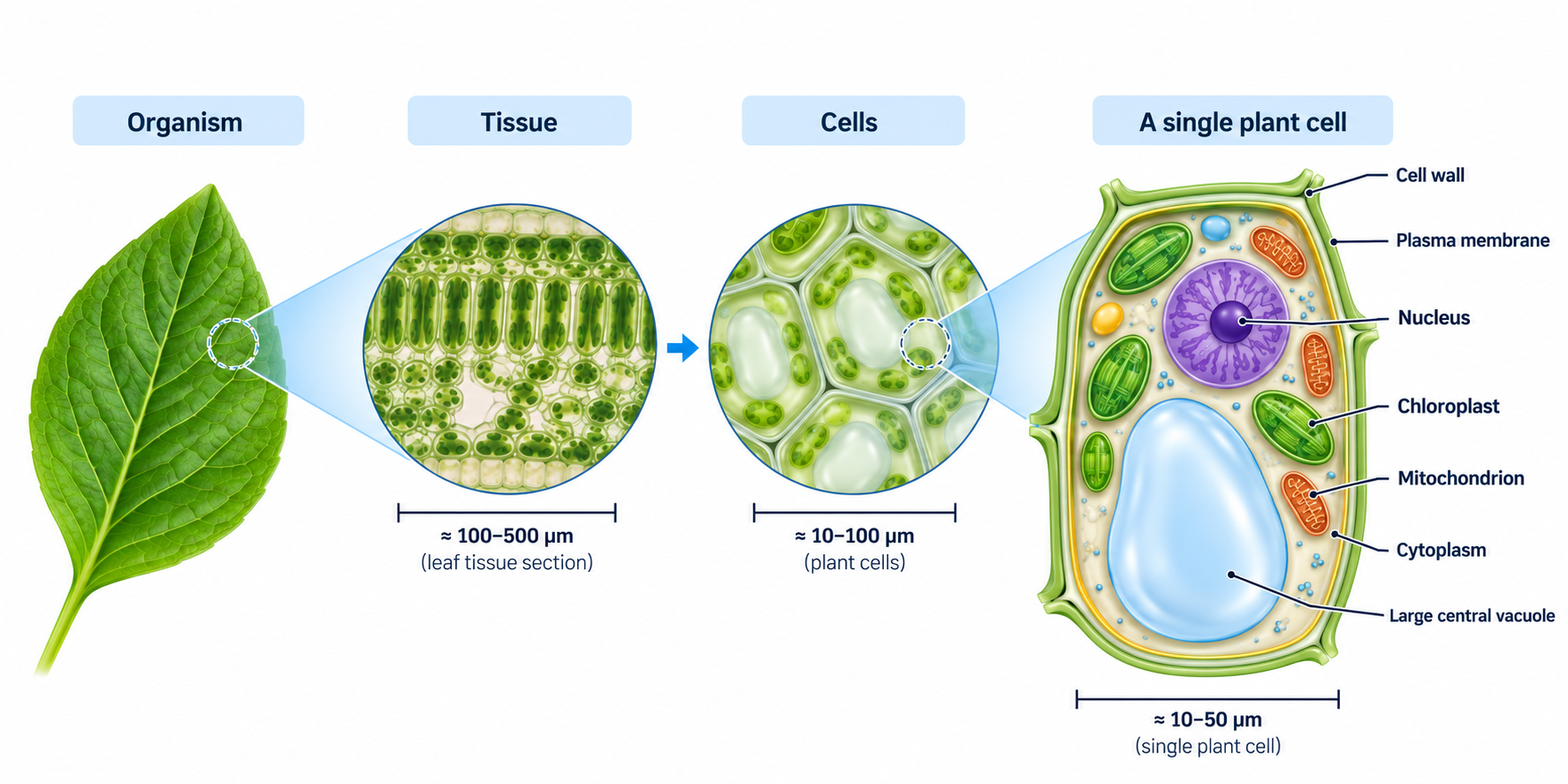
Imagine looking at a leaf. At first you see a continuous green surface. Under a microscope, that surface resolves into many small compartments. Each compartment is a cell with its own boundary and contents. A living bacterium is different: it is just one cell, yet it can obtain nutrients, release waste, use genetic information and reproduce. These two examples show why the cell is the common building unit of organisms even when their sizes differ enormously.
A cell membrane is especially important. It defines an inside and an outside, allows the cell to maintain conditions different from its surroundings, and regulates exchange. Within that boundary, enzymes coordinate chemical reactions and genetic information helps direct cellular activities. A bag of isolated molecules is not automatically a functioning cell: the organisation of those processes matters.
Three principles that connect the observations
Cell theory brings these observations together into three fundamental principles. Each explains a different aspect of how living organisms are organised and how cells continue from one generation to the next.
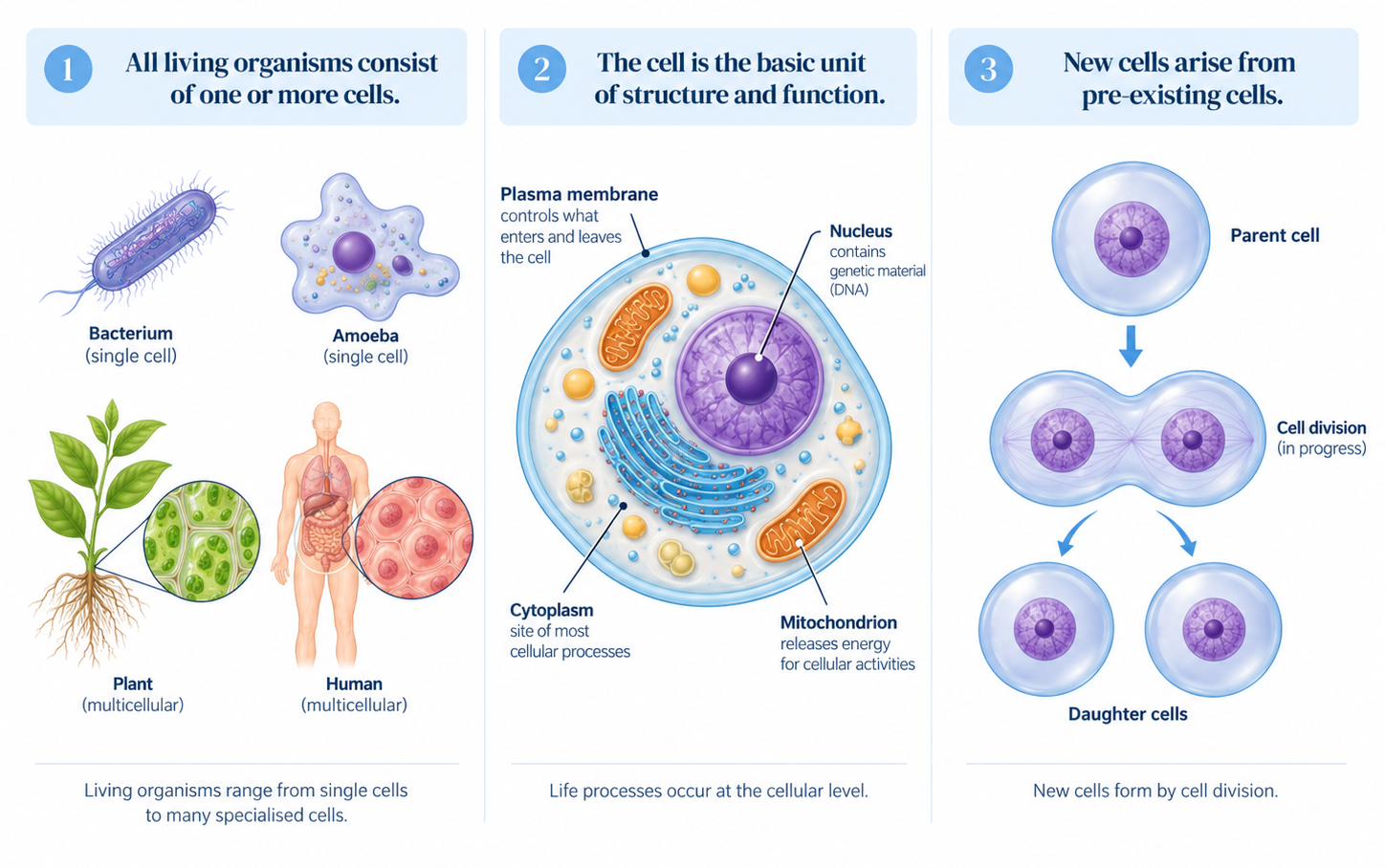
Notice that the middle panel represents function as well as structure: chemical reactions and controlled exchange occur within cells, while tissues coordinate the work of many cells. Being the basic functional unit does not mean every specialised cell can survive on its own outside the organism.
The division panel shows continuity of cells. Modern cell theory describes how cells reproduce in living organisms; it is not a claim about exactly how the first cell originally arose on Earth.
What cell theory does not mean
A cell need not have a nucleus: bacteria and archaea are cellular organisms without membrane-bound nuclei. A mature mammalian red blood cell lacks a nucleus but is still a specialised cell. Viruses, which depend on host cells for replication, are not themselves cells; their structure and biological status are covered in Lesson 07.
If a question claims that all cells contain a nucleus, look for a counterexample such as a prokaryote. If it claims a tissue is the smallest functioning unit, remember that tissue function depends on the activities of its constituent cells.
Microscopy and the scale of cells
Images of cells are commonly enlarged, but an image that looks large does not tell you whether the original object was large. Always separate actual size, image size and magnification.
First distinguish the real cell from the image
Imagine a cell that is 50 micrometres long. On a screen, its image might be 5 centimetres long. The cell itself has not grown: the microscope has produced a larger representation. This is why the length you measure with a ruler on a micrograph is not usually the real length of the specimen.
A microscope helps in two different ways. It makes tiny objects appear larger, and, if its resolving power is sufficient, it lets you distinguish nearby details. Those are different achievements.
Magnification is not resolution
Magnification tells you how many times larger an image is than the object. For example, an image 20 mm long of an object 0.05 mm long has a magnification of 20 ÷ 0.05 = 400×.
Resolution is the ability to distinguish two nearby points as separate. Enlarging a blurred image does not reveal structures that were never resolved. Light microscopes are constrained by visible-light wavelength and have a typical resolution limit around 0.2 µm under favourable conditions. Electron microscopes can resolve much finer detail, although specimen preparation and imaging conditions differ.
Why micrometres and nanometres appear in Biology
A millimetre is already a small distance on a ruler, but many cells are far smaller. The prefix micro- means one millionth, so a micrometre (µm) is one millionth of a metre. The prefix nano- means one billionth: a nanometre (nm) is one billionth of a metre. These units let us discuss cells, membranes and molecular structures without strings of zeros.
Keep measurement units consistent
A common error is dividing lengths expressed in different units. Convert first: 3 cm on an image is 30 mm or 30,000 µm. If the original structure measures 60 µm, magnification = 30,000 µm ÷ 60 µm = 500×.
Why a scale bar is more reliable than a printed magnification
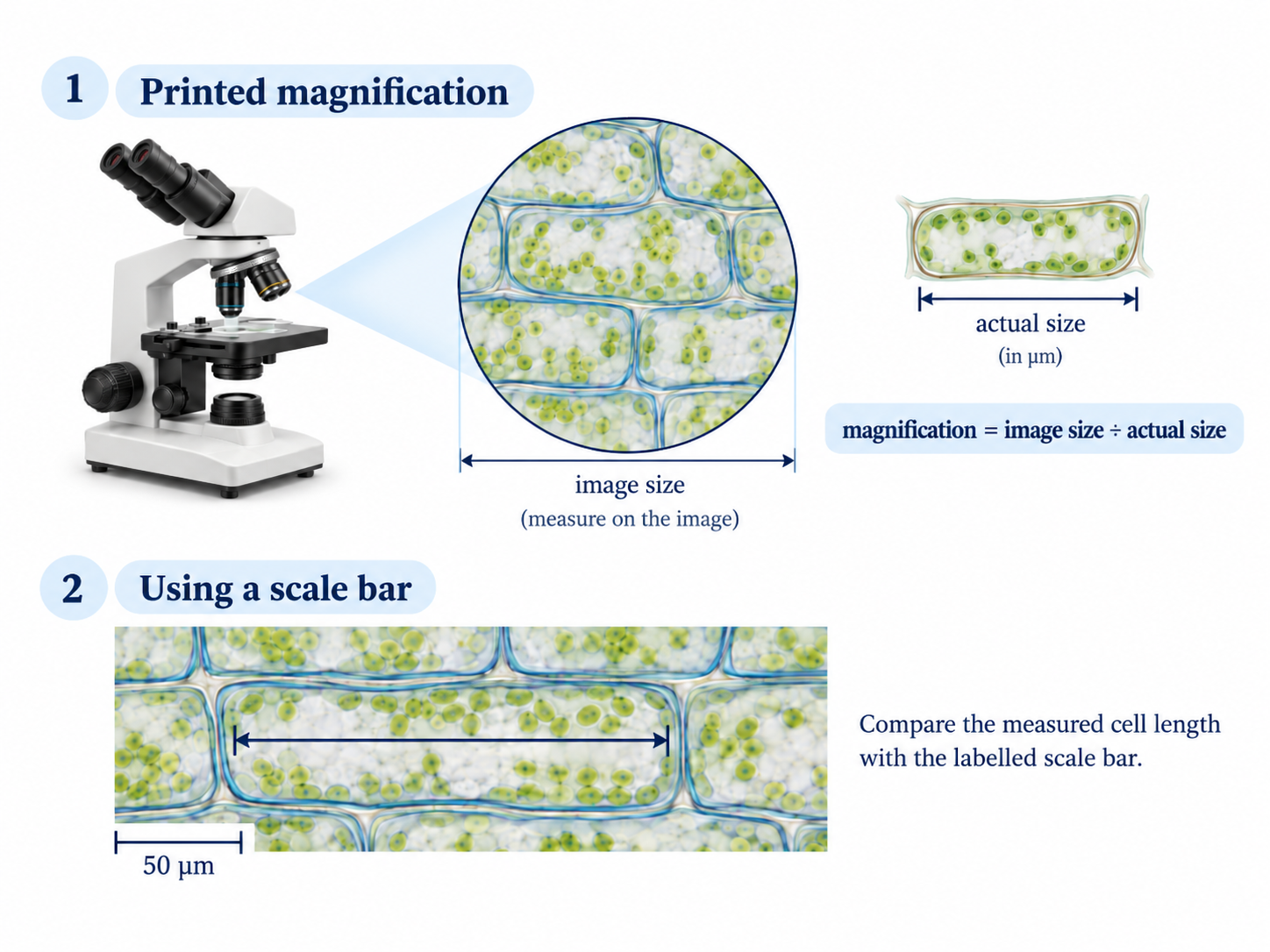
A printed magnification such as 500× is accurate only while the image remains at its original displayed size. If the image is enlarged or reduced, that number may no longer be valid. A scale bar changes size along with the image, so you can compare the specimen and the bar on the same imageto calculate the specimen’s actual size.
For microscopy questions, write image size ÷ actual size = magnification, convert all units, and then calculate. With a scale bar, compare lengths measured on the same image before converting to the real size.
Why do most cells remain relatively small?
A cell obtains materials across its outer membrane and uses them throughout its interior. Growing larger increases internal demand faster than it increases available surface area. This creates a key exchange constraint.
How cell size affects the exchange of materials
Enzymes inside the cytoplasm are using nutrients and, in many cells, oxygen to support metabolism. Waste products must leave, while useful molecules have to enter. Each exchange happens across a boundary, usually the plasma membrane. The cell's interior is where many of those resources are needed. So two quantities matter: the surface available for exchange and the amount of interior that requires support.
Now imagine the cell becoming wider, taller and deeper without changing its shape. It has more membrane in total, but also much more interior. The biological question is not simply whether its membrane gets larger. It is whether that membrane increases quickly enough relative to the volume that needs supplying.
Compare the two cells below. Follow the arrows showing materials entering and wastes leaving, then notice the distance from the membrane to the interior. Which cell has more interior to support relative to its outer surface?
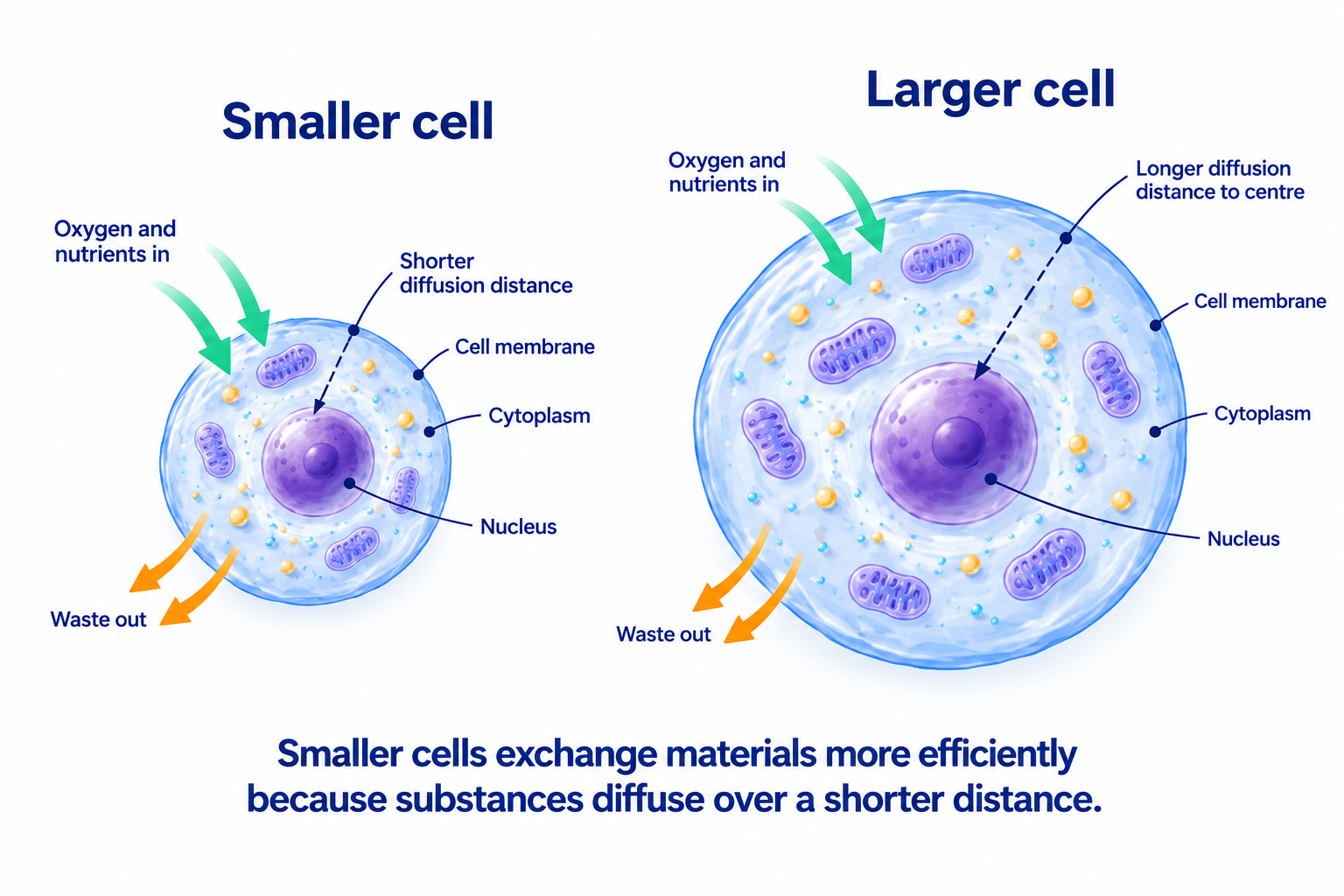
The larger cell has more membrane in total, but it also contains substantially more cytoplasm. As similar-shaped cells grow, volume increases faster than surface area. At the same time, substances may have farther to diffuse to reach where they are needed. These are two related reasons why cell size matters.
More surface area does not always mean enough surface area
A larger cell usually has more total membrane area than a smaller cell of the same shape. But its interior volume increases more rapidly. That meansless membrane is available for each unit of cytoplasm, even though the larger cell has more membrane overall. Section 04 will show exactly why with a simple geometric comparison.
Surface-area-to-volume ratio is not the only factor controlling exchange: membrane permeability, transport proteins, concentration gradients and metabolic demand also matter. The ratio helps predict a constraint; it does not, by itself, give the rate of every transport process.
Diffusion distance also matters
A substance entering through the membrane must still reach the parts of the cell where it is needed. In a larger cell, the journey toward the centre is generally longer, so delivery by diffusion alone tends to take more time. Cells can reduce this limitation through specialised shapes, internal organisation or transport mechanisms.
Do not answer “large cells have less surface area.” They usually have more total surface area, but less surface area available per unit volume when shape is held constant.
Surface area to volume: the geometry behind the biology
Suppose a cell keeps the same shape while its linear dimensions change. Surface area grows with the square of its linear size; volume grows with the cube.
Begin by counting, not memorising a formula
Take a cube with side length 1 unit. It has six square faces, each with area 1 × 1 = 1 square unit. Add them and you get 6 square units of surface. Its interior occupies 1 × 1 × 1 = 1 cubic unit.
Make each side 2 units instead. Each face now has area 2 × 2 = 4, so the six faces have total area 24. The interior occupies 2 × 2 × 2 = 8. Doubling the length made the area four times larger but the volume eight times larger. This is the geometric reason larger similarly shaped cells have less membrane per unit of interior.
Express the pattern as a reusable formula
We do not need to calculate every face separately each time. For a cube, six equal faces give surface area 6a² and its three-dimensional interior gives volume a³, where a is the side length. Dividing the two quantities gives 6/a. The smaller the side, the greater the area-to-volume ratio.
Compare three sizes to see the trend
Compare the three cubes below. As the side length grows, ask how much outer surface is available for each unit of interior volume. Use the values to test the pattern you just derived.
These ratios have units of inverse length if numerical measurements have units. Exam problems often present them as comparisons using a common length unit. The general pattern is the important part: larger similar shapes have lower surface area relative to volume.
Apply the same rule to a sphere
A spherical cell has surface area 4πr² and volume 4πr³/3, so SA:V = 3/r. The ratio falls as radius increases. The exact shape changes the constant but not the underlying scaling pattern for geometrically similar objects.
What happens if one large cube divides?
Imagine a cube of side 2 dividing into eight cubes of side 1, without loss of material. Total volume stays 8 cubic units. The original outer area is 24 square units; the eight smaller cubes together provide 8 × 6 = 48 square unitsof surface area. Subdivision can increase the membrane area available for exchange, though real cell division requires membrane production and complex regulation.
How biological systems overcome exchange limits
Organisms do not solve exchange problems only by staying small. They can alter cell shape, create folds or extensions, maintain gradients, or move substances through specialised transport systems.
First ask what the cell is trying to exchange
A cell absorbing dissolved nutrients needs access to material outside it. If it can add membrane folds or projections, it exposes more membrane to that material without needing an equally large increase in its interior. By contrast, if oxygen must pass through a tissue barrier, making that barrier thinner shortens the distance oxygen has to diffuse. These adaptations solve related but different parts of the exchange problem.
Shape can increase area without the same rise in volume
A long, thin cell, a flattened cell or a cell with membrane projections can have a relatively large exchange surface compared with its volume. Microvillion intestinal epithelial cells provide additional membrane surface for absorption. The folds do not themselves supply energy; they increase the available surface for transport processes.
Thin barriers reduce the distance to cross
Thin exchange surfaces, including alveolar and capillary walls, shorten diffusion pathways. Ventilation and blood flow help maintain concentration differences across respiratory surfaces. These adaptations work together: more area is useful only if substances can cross the barrier and gradients are maintained.
Multicellular life changes the problem
Large animals cannot rely on diffusion from the external environment to every cell. Internal transport systems distribute nutrients and gases near cells, while specialised exchange surfaces connect those systems to the outside. This is why increasing organism size does not require every individual cell to become proportionally larger.
When asked which adaptation improves exchange, check the mechanism: greater area, shorter diffusion path, larger maintained concentration gradient, or more transport capacity. Avoid explanations that confuse an increased total surface with a higher SA:V ratio.
Put the ideas together in unfamiliar questions
IMAT reasoning often combines a biological observation with a simple measurement or geometric rule. Identify the quantity that changes, preserve the units, and avoid drawing a conclusion stronger than the data justify.
How to approach an IMAT question before looking at A–E
First identify the comparison: does the question change cell size, shape, membrane properties or the concentration gradient? Next decide whether it asks about total surface area or surface area per unit volume. If all linear dimensions are multiplied by a factor, area changes by that factor squared and volume by the factor cubed. Only after making that prediction should you inspect the answer options.
Example: why equal volume does not mean equal exchange area
Two cell populations have the same total cytoplasmic volume. One population consists of many small cells; the other consists of a few much larger, geometrically similar cells. The many smaller cells generally have a greater combined outer membrane area, because splitting a fixed volume into smaller similar units increases total surface area. This geometric prediction assumes smooth boundaries and does not account for every real biological transport constraint.
Example: interpreting an unexpected result
If a larger cell exchanges a substance faster than a smaller one, that result does not invalidate the surface-area-to-volume principle. It may have more transport proteins, a steeper concentration gradient, membrane folds or a higher total membrane area. Always ask which variables were controlled.
You should now be able to explain the three statements of cell theory, distinguish magnification from resolution, use scale bars and unit conversions, calculate surface-area-to-volume ratios for simple shapes, and predict how changing cell size or shape can affect exchange. Advanced microscopy optics and detailed diffusion equations are beyond the scope of this lesson.