
BIOLOGY · FOUNDATIONS · LESSON 03
Biological molecules
A cell has several molecular problems to solve: it needs readily available fuel, compact energy stores, membranes, catalysts, structural materials and a way to store information. The major biological molecules make sense when you ask what structural feature solves each problem rather than trying to memorise four separate lists.
JUMP TO SECTIONWhy cells need different molecular designs1/6
Why cells need different molecular designs
Start with the job, not the name of the molecule. A molecule that must dissolve and move quickly through cytosol needs different properties from one that must form a stable membrane or store information for years. Structure is the solution to the biological problem.
One cell, several very different molecular problems
Small polar molecules can remain dispersed in water and reach enzymes easily. This is useful for fuels and metabolic intermediates.
Packaging many glucose units into larger structures greatly reduces the number of separate osmotically active particles for the same stored amount of glucose.
A membrane needs molecules with one region that interacts with water and another that avoids it. Amphipathic structure solves that problem.
Information requires an ordered sequence that can be copied. Nucleic acids use a stable covalent backbone with a variable sequence of bases.
Building units matter because joining them creates new behaviour
Lesson 01 introduced condensation and hydrolysis. Here is why they matter. Joining small units does not merely make a molecule larger. It changes the number of separate particles, creates a new covalent framework and can produce a chain that bends, branches, folds or aligns with other chains.
Polymer is a structural description, not a synonym for biomolecule
A polymer is built by repeating linked subunits. Proteins, nucleic acids and many carbohydrates fit this idea well. Lipids do not all fit it. A triglyceride is assembled from glycerol and fatty acids, but it is not a repeating chain of one monomer type.
Large biological molecule does not automatically mean polymer. Learn the actual construction pattern of each class instead of forcing every molecule into the monomer → polymer model.
A useful reading method for every molecule in this lesson
Do not begin by asking “what facts do I know about this molecule?” Begin with four questions: what is it built from, what joins the parts, what larger shape or arrangement results, and what property follows from that structure? The biological role then becomes much easier to predict.
Carbohydrates are the clearest place to see the rule. The building unit can stay almost the same while the way units are linked changes the final shape and function.
Carbohydrates
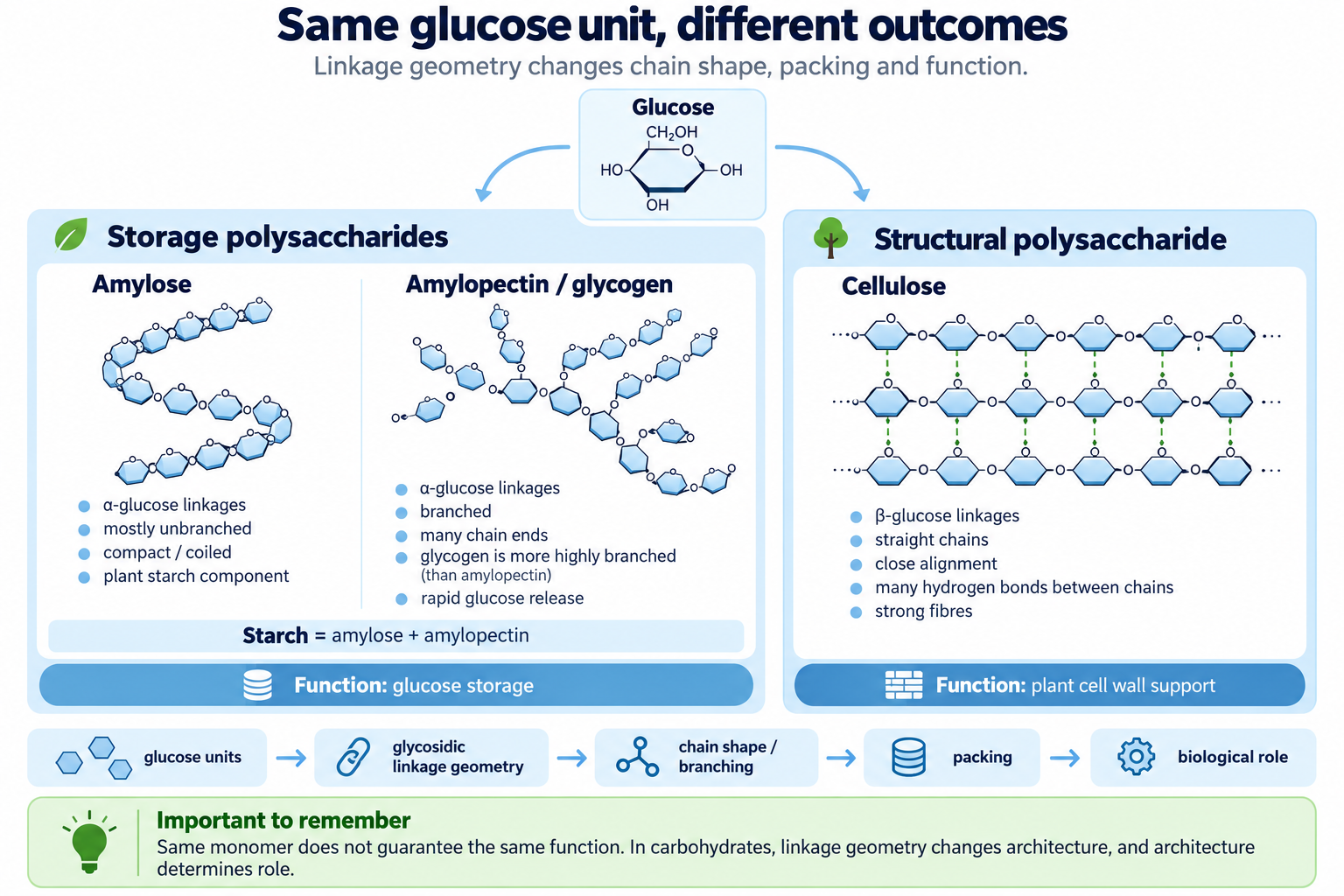
Glucose can be used immediately in metabolism, but cells also need to store glucose and build structural materials from sugar units. The key is not “carbohydrates = energy.” The key is how sugar units are linked and organised.
Why is glucose useful as a small molecule?
Glucose contains several hydroxyl groups (–OH). Those polar groups allow favourable interactions with water, so glucose can remain dissolved in aqueous cell fluids and move to enzymes that use it in metabolism.
But keeping a very large number of glucose molecules as separate dissolved particles would increase the number of osmotically active solute particles inside the cell. A storage molecule solves that problem by packaging many glucose units into a much smaller number of particles.
Joining sugars creates glycosidic bonds
Two monosaccharides can undergo condensation to form a glycosidic bond. Repeating that process builds a polysaccharide. The important next question is not simply “is it made of glucose?” but which orientation and pattern of glycosidic linkage is present?
Why do starch and glycogen work as stores?
Starch is a major glucose store in plants and contains two components: amylose, which is mostly unbranched and coils, and amylopectin, which is branched. Glycogen is the main storage polysaccharide in animals and fungi and is even more highly branched.
Branching creates many chain ends. Enzymes that add or remove glucose can act at those ends, so the highly branched architecture of glycogen supports rapid mobilisation when glucose is needed.
Why does cellulose behave so differently if it is also made from glucose?
Cellulose uses β-glucose-derived linkages. The geometry of the linkage produces long, straight chains. Neighbouring chains can align and form many hydrogen bonds with one another, creating strong fibres suitable for plant cell walls.
Lipids solve a different problem. Their long non-polar regions behave very differently from the hydroxyl-rich surface of carbohydrates.
Lipids
Lipids make sense when you start with water. Their large non-polar regions interact poorly with water, and that single physical fact helps explain energy storage, membrane formation and the behaviour of many signalling molecules.
Why is a fatty-acid tail hydrophobic?
A fatty acid has a carboxyl group at one end and a long hydrocarbon chain containing many C–C and C–H bonds. The hydrocarbon region is largely non-polar, so it cannot form the same favourable interactions with water as polar or charged groups can.
How does a triglyceride form?
One glycerol molecule contains three hydroxyl groups. Each can react with the carboxyl group of a fatty acid. Three condensation reactions form three ester bonds, producing a triglyceride and releasing water.
Why are triglycerides energy-dense?
Fatty-acid chains contain many highly reduced carbon atoms, so oxidation of those chains can release substantial chemical energy. Triglycerides are also stored in a largely anhydrous form because they are hydrophobic. Together, those features make fat a compact long-term energy store.
Why does a cis double bond change physical behaviour?
A saturated fatty-acid chain has no C=C double bond and can remain relatively straight. A cis unsaturated double bond introduces a bend. Bent chains cannot pack together as tightly, weakening collective short-range interactions between neighbouring hydrocarbon chains.
This is why increasing cis unsaturation generally lowers melting temperature and, in membrane lipids, tends to increase fluidity.
Why are phospholipids suited to membranes?
A phospholipid combines a polar head region with non-polar fatty-acid tails. That makes it amphipathic. In water, the hydrophobic effect favours arrangements in which tails cluster away from water while heads remain exposed.
The result is not an arbitrary diagram to memorise: the bilayer follows from the molecule's mixed polarity.
Why do steroids still count as lipids without fatty-acid tails?
Steroids have a four-ring carbon framework rather than glycerol plus fatty acids. Most of that framework is non-polar, so steroids still show lipid-like behaviour. Cholesterol, for example, has a small polar –OH group attached to a much larger hydrophobic ring system.
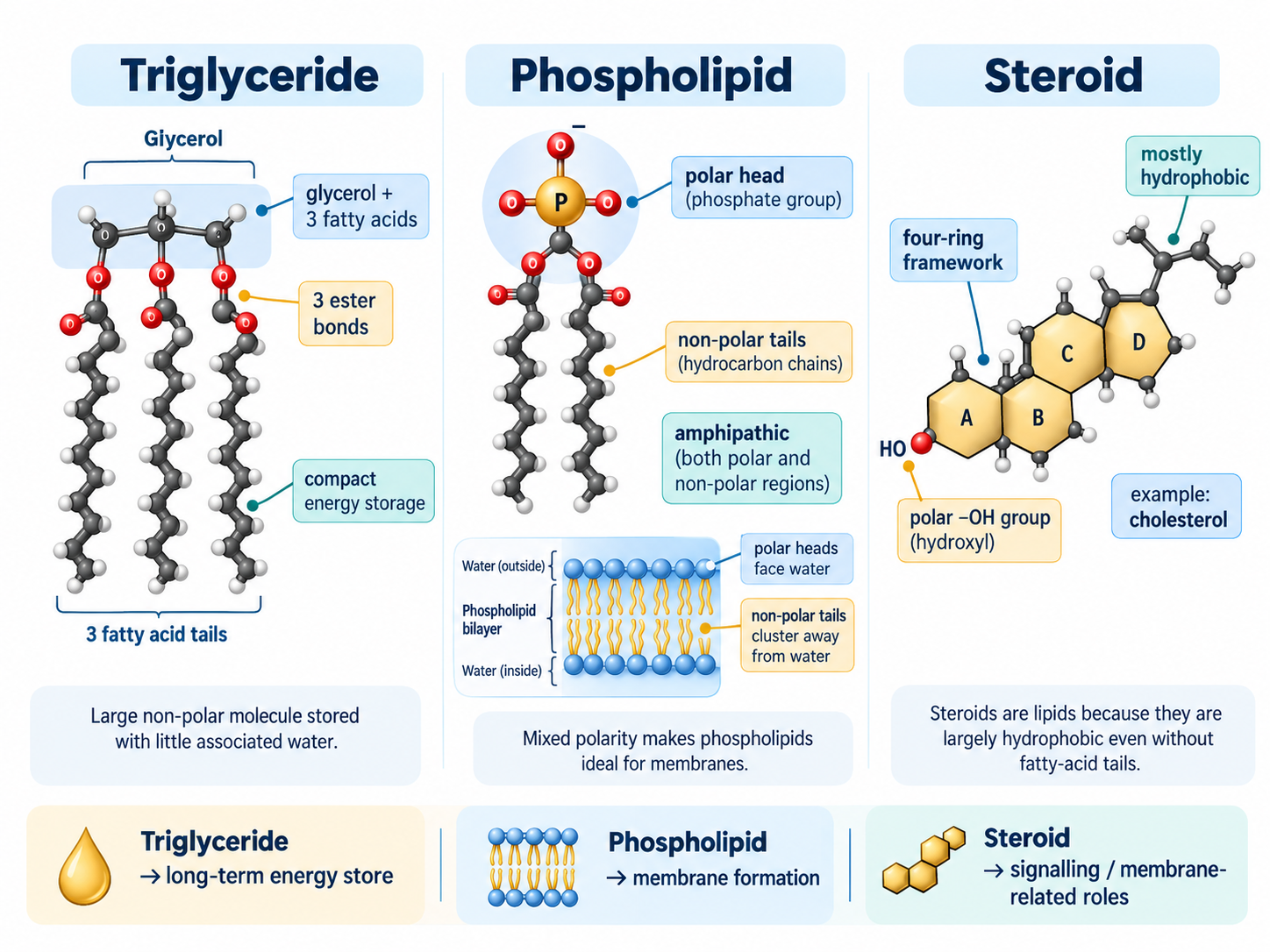
Lipids are a chemically diverse group. Triglycerides, phospholipids and steroids are connected more by extensive hydrophobic character than by one universal monomer or one universal bond type.
Proteins introduce a new idea: the chemical pattern along a chain controls how that chain folds, and folding creates the surfaces that perform biological work.
Proteins
Proteins solve a precision problem. An enzyme must hold reacting groups in the right positions; a receptor must recognise one signal better than another; a structural protein must resist particular forces. A simple chain cannot do those jobs until it folds into a specific three-dimensional surface.
A protein begins as a sequence, not a shape
Every standard amino acid has the same basic backbone but a different R group. Some R groups are non-polar, some are polar and some can carry full charges. So an amino-acid sequence is also a sequence of chemical properties.
Changing one amino acid can therefore do more than change a name in a sequence. It can replace a hydrophobic region with a charged one, remove a hydrogen-bond donor, introduce steric crowding or alter the local flexibility of the chain.
Peptide bonds make the chain; side chains decide how the chain behaves
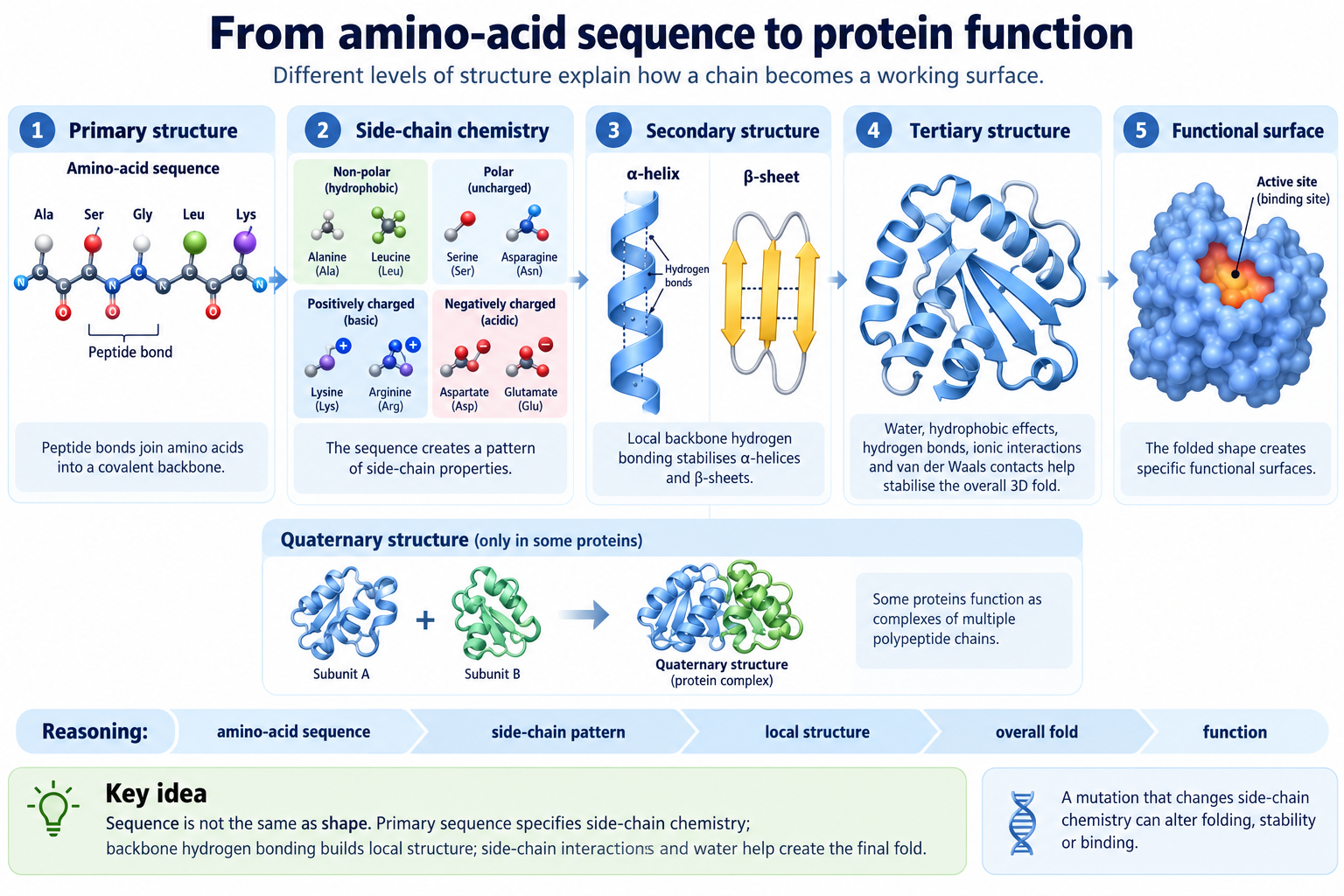
The carboxyl group of one amino acid reacts with the amino group of another in a condensation reaction, forming a peptide bond. Repeating peptide bonds creates a strong covalent backbone with a defined amino-acid order.
The peptide backbone keeps the chain connected. The pattern of side chains then determines which parts favour water, which avoid it, which can attract or repel one another and where hydrogen bonds or other close contacts can form.
Put the chain in water and folding becomes easier to understand
For many soluble proteins, a newly made polypeptide is surrounded by water. Non-polar side chains tend to become buried away from water, while many polar or charged groups can remain exposed. Within the chain, hydrogen bonds, electrostatic attractions, van der Waals contacts and, where present, covalent disulfide bonds help stabilise particular arrangements.
Folding is therefore not a random collapse. It is the result of the chemical pattern along the chain interacting with itself and with the surrounding aqueous environment.
The “levels” of protein structure are different views of the same molecule
The amino-acid order held together by peptide bonds. A sequence change can alter every higher level.
α-helices and β-sheets are local arrangements stabilised mainly by hydrogen bonds between peptide-backbone groups.
The overall three-dimensional shape produced by interactions among side chains, the backbone and water.
Some proteins function as complexes of two or more polypeptide subunits. Only those proteins have quaternary structure.
Follow one substitution all the way to function
Imagine a non-polar side chain buried inside a protein core is replaced by a charged side chain. The new group interacts much more favourably with water and may fit poorly in the original hydrophobic environment. Local packing can change, the fold may become less stable and a distant active site or binding surface may lose its precise geometry.
Why can denaturation destroy function without cutting the chain?
Heat, extreme pH or other disruptive conditions can weaken the interactions that maintain higher-order structure. If the fold changes, an active site or binding surface can lose its geometry. The protein may therefore lose function while most peptide bonds — and therefore the primary sequence — remain intact.
Denaturation usually disrupts higher-order structure before primary structure.Breaking peptide bonds is a different chemical event from unfolding a protein.
Nucleic acids solve that problem by separating the molecule into a repeating covalent backbone and a variable sequence of bases.
Nucleic acids
An information molecule needs two things that seem almost opposite: a chemically reliable framework that can persist, and a sequence that can vary from one gene to another. DNA and RNA solve this by using a repeating backbone while allowing the bases to carry the variable information.
A nucleotide has a repeating part and a variable part
Every nucleotide contains a phosphate group, a five-carbon sugarand a nitrogenous base. The phosphate and sugar become part of the repeating backbone; the base projects from that backbone and can vary from one nucleotide to the next.
Creates continuity and direction along the strand. The chemistry of the backbone is similar from one nucleotide position to the next.
The order of A, T, G and C in DNA — or A, U, G and C in RNA — is what makes one sequence different from another.
Phosphodiester bonds turn nucleotides into a directional strand
Nucleotides join through strong covalent phosphodiester bonds. Because the sugars are linked through defined positions, the two ends of a strand are chemically different and are described as the 5′ end and 3′ end.
Direction matters because cellular enzymes do not treat the two ends as equivalent. Later, this will become essential when we study DNA replication, transcription and the direction in which new nucleic acid is synthesised.
Complementarity makes a sequence readable and copyable
In DNA, A pairs with T and G pairs with C because their hydrogen-bonding patterns are complementary. That means the sequence on one strand specifies which bases can pair on the other strand.
The two strands therefore run in opposite directions and are described as antiparallel. Complementarity is more than a structural detail: it is the logic that later allows sequence information to be copied.
Backbone bonds and base-pair interactions do different jobs
Phosphodiester bonds are covalent links that keep each strand intact. Hydrogen bonds help complementary bases recognise one another across paired regions. Separating two DNA strands can therefore occur without cutting the covalent backbone.
Hydrogen bonds are not the only contribution to DNA duplex stability; base stacking and other short-range interactions also matter. But complementary hydrogen-bonding patterns explain why pairing is selective.
RNA changes the design without abandoning the same logic
RNA uses ribose instead of deoxyribose and usually uses uracil (U) instead of thymine (T). It is often single-stranded, but single-stranded does not mean unstructured. Complementary regions within the same RNA molecule can pair with one another, allowing the strand to fold into functional shapes.
That is why RNA can do more than simply carry a message: different RNA molecules can also contribute to structure, recognition and catalysis. Those specialised roles will make more sense after the basic sequence-and-folding logic is secure.
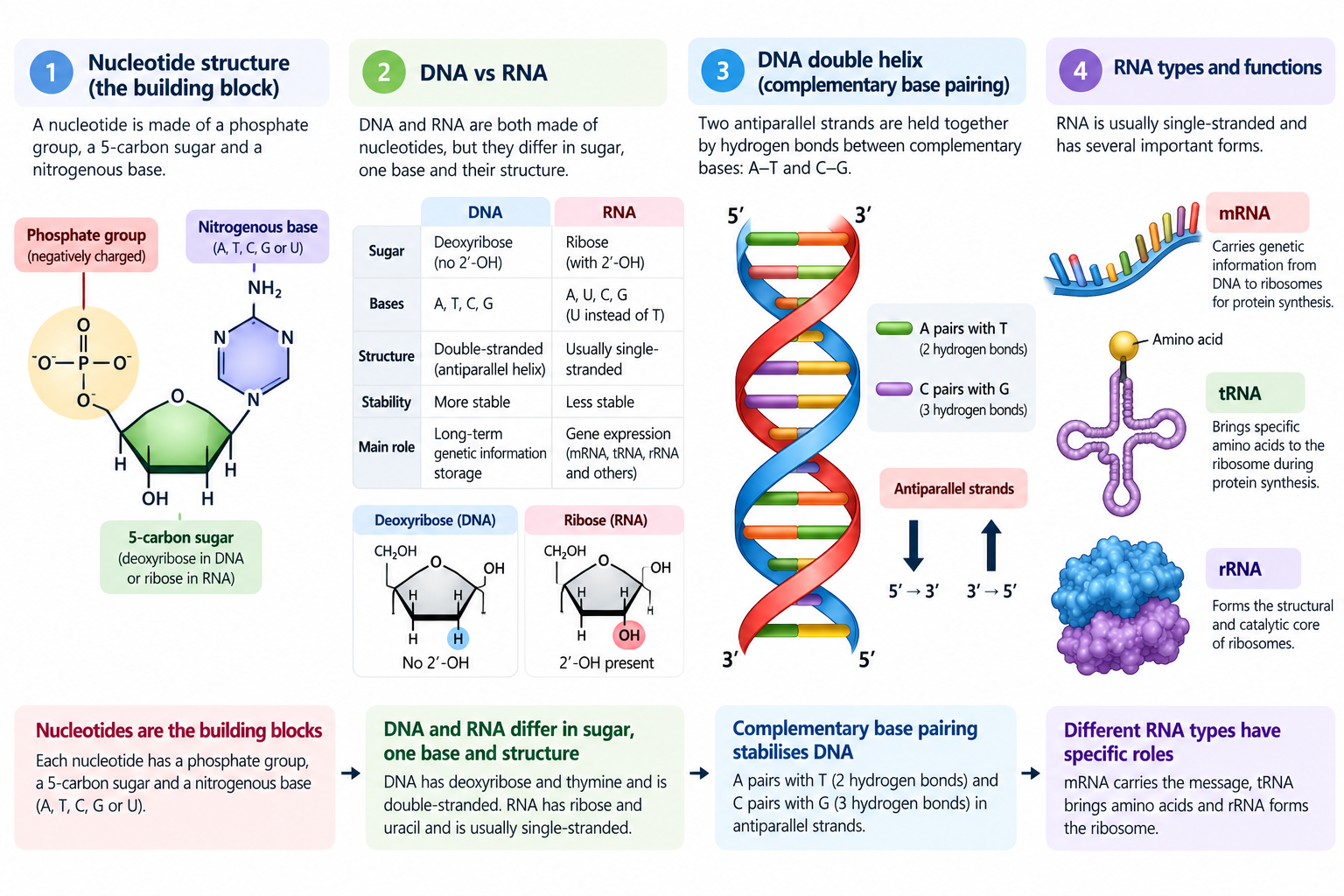
The backbone provides continuity; the bases provide sequence information.Complementary weak interactions then let that sequence be recognised without permanently covalently joining the two strands.
The final section combines the clues from all four classes so you can reason from construction, chemistry and shape instead of relying on recognition alone.
Read the molecule from its clues
In an unfamiliar question, do not search your memory for the exact picture first. Read what the structure is telling you. A few diagnostic clues usually identify the class and predict the behaviour.
Start with the most diagnostic structural clue
Repeated sugars, an amino-acid backbone, a nucleotide backbone, or a large hydrophobic framework?
Glycosidic, ester, peptide or phosphodiester bonds tell you how the structure was assembled.
Polarity, charge, branching, rigidity, hydrophobicity or flexibility?
Rapid fuel, storage, support, membrane formation, catalysis, recognition or information storage?
Use cause and effect rather than one-word associations
“Carbohydrate = energy,” “lipid = fat,” “protein = enzyme” and “DNA = genetics” are too crude for reasoning questions. Cellulose is a carbohydrate used for structure. Phospholipids are lipids used for membranes. Many proteins are structural or transport molecules rather than enzymes. RNA can have structural and catalytic roles as well as carrying information.
At this stage, learn building units, characteristic bonds, structural organisation and major functions. Detailed DNA replication, metabolism and enzyme kinetics are deliberately saved for later lessons where those mechanisms can be taught in full.