
BIOLOGY · FOUNDATIONS · LESSON 02
Weak interactions in biology
Biological structures are not held together only by strong covalent bonds. Many of the shapes, pairings and assemblies that make cells work depend on large numbers of weaker, reversible interactions acting together in water.
JUMP TO SECTIONRole of weak interactions1/7
Role of weak interactions
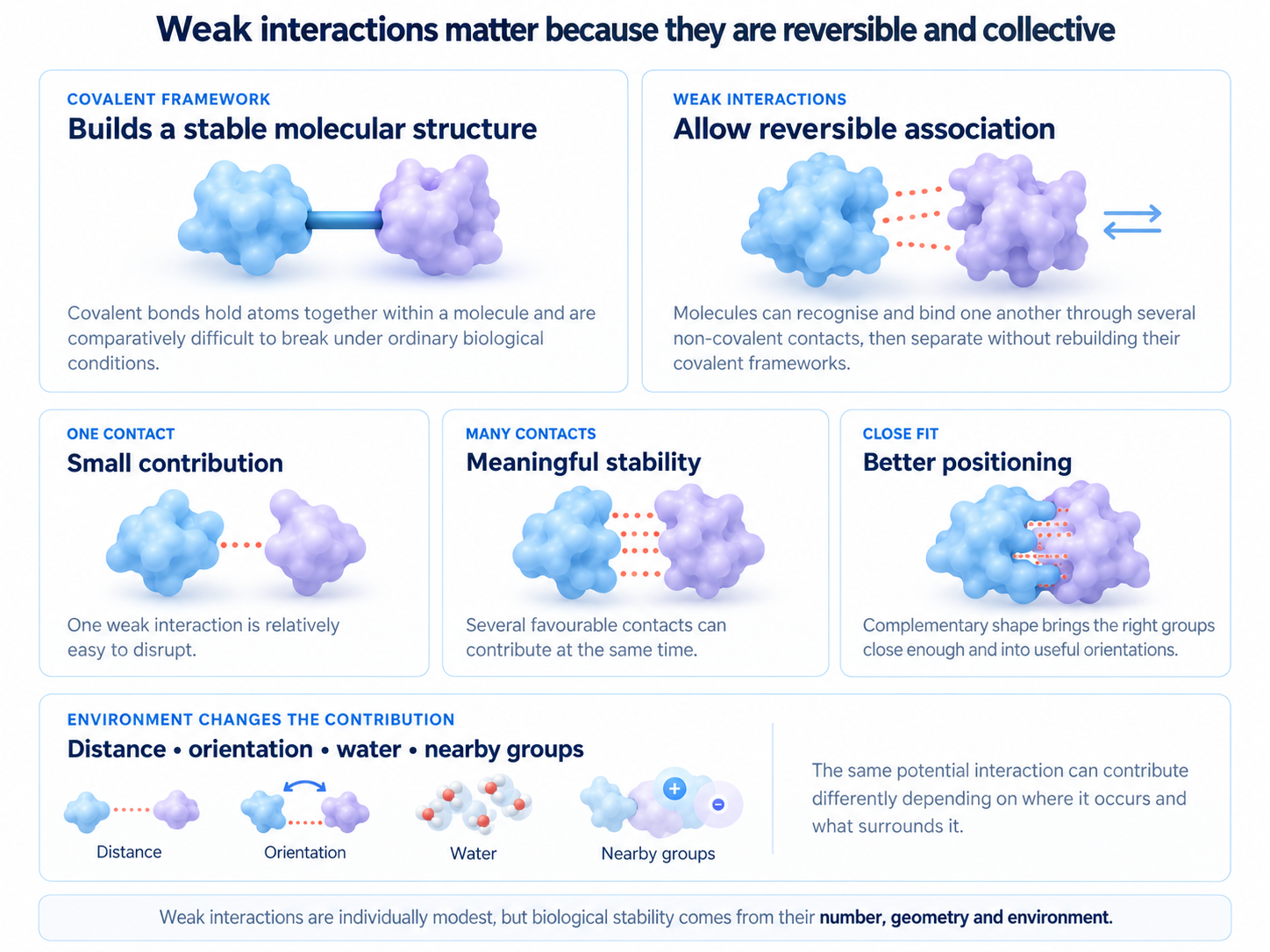
Covalent bonds are excellent for building durable molecular frameworks. They hold atoms together inside carbohydrates, proteins, lipids and nucleic acids. But living systems also need molecules to meet, recognise one another, bind for a while and then separate again. That requires a different kind of interaction: strong enough to matter, but weak enough to be reversible.
Cells need molecules to bind without becoming permanently linked
Imagine an enzyme meeting its substrate or a receptor meeting a signalling molecule. The two molecules must come together in a very specific way. If nothing held them together, recognition would be unreliable. But if they formed permanent covalent bonds every time they met, the system would quickly become locked in place.
Biology therefore makes heavy use of non-covalent interactions. These interactions do not join atoms into a new covalent framework. Instead, they help molecules associate through charge, polarity, close contact and the behaviour of water.
How can something weak still stabilise a structure?
One weak interaction can be disrupted relatively easily. But biological molecules rarely rely on only one contact. When two surfaces fit well, many small favourable interactions can form at the same time. Breaking the whole association then means losing many contacts together.
Why weakness is actually useful to Biology
Enzymes release products, receptors release ligands and DNA-binding proteins must attach and detach. Weak interactions make this reversibility possible.
Not every molecule makes the same set of favourable contacts. Charge, polarity and shape can make one partner fit better than another.
Several individually small interactions can contribute at the same time. Losing one contact may have only a small effect, while losing several can greatly reduce overall stability.
Shape matters because most weak interactions need close contact
Two molecules cannot benefit from an interaction simply because they contain the right chemical groups somewhere in their structures. The groups must be brought close enough and into a suitable orientation. That is why molecular shape and complementarity matter so much.
A well-matched binding site can place several polar groups, charged groups and non-polar surfaces in useful positions at the same time. A poorly fitting molecule may contain the same chemical groups but fail to place them where they can interact.
Before naming an interaction, ask: which groups are close enough to interact, and what is the chemical environment around them?
The surrounding environment changes what an interaction contributes
Most biological interactions happen in water. Water can surround charged and polar groups, compete for hydrogen bonds and change how strongly two molecular groups interact with each other. The same pair of groups can therefore contribute differently when exposed to water than when buried inside a protein or membrane.
That is why a fixed “strength ranking” can mislead you
It is tempting to memorise a list from “strongest” to “weakest”, but real biological structures are more complicated. The contribution of an interaction depends on distance, orientation, solvent, neighbouring groups and how many contacts occur together.
Start with the polarity you already know, then follow what happens when a partially positive hydrogen approaches a suitable electronegative atom.
Hydrogen bonds
The ability to form a hydrogen bond comes from a polar covalent bond. When hydrogen is covalently bonded to a strongly electronegative atom such as oxygen or nitrogen, the shared electrons are pulled away from H. That leaves the H with partial positive character — and creates the possibility of attraction to electron density nearby.
Step 1 · Start inside the O–H or N–H bond
Take an O–H bond in water. Oxygen attracts the shared electrons more strongly than hydrogen does. The electrons are still shared — so this is still a covalent bond — but the sharing is unequal. Oxygen becomes partially negative (δ−) and hydrogen becomes partially positive (δ+).
This is a polar covalent bond. The atoms are joined by shared electrons, but those electrons spend more time closer to O.
O carries δ− character and the attached H carries δ+ character. These are partial charges, not full ionic charges.
Step 2 · Now bring electron density close to that δ+ hydrogen
The partially positive H can be attracted to a nearby electronegative atom that has available electron density. In biological molecules, oxygen and nitrogen are common participants. The H remains covalently attached to its original atom; the new attraction is a separate, weaker interaction.
The solid O–H or N–H covalent bond keeps H attached to its own atom. The dotted H···acceptor attraction is the hydrogen bond to a second atom. Forming the hydrogen bond does not mean H has left its original covalent bond.
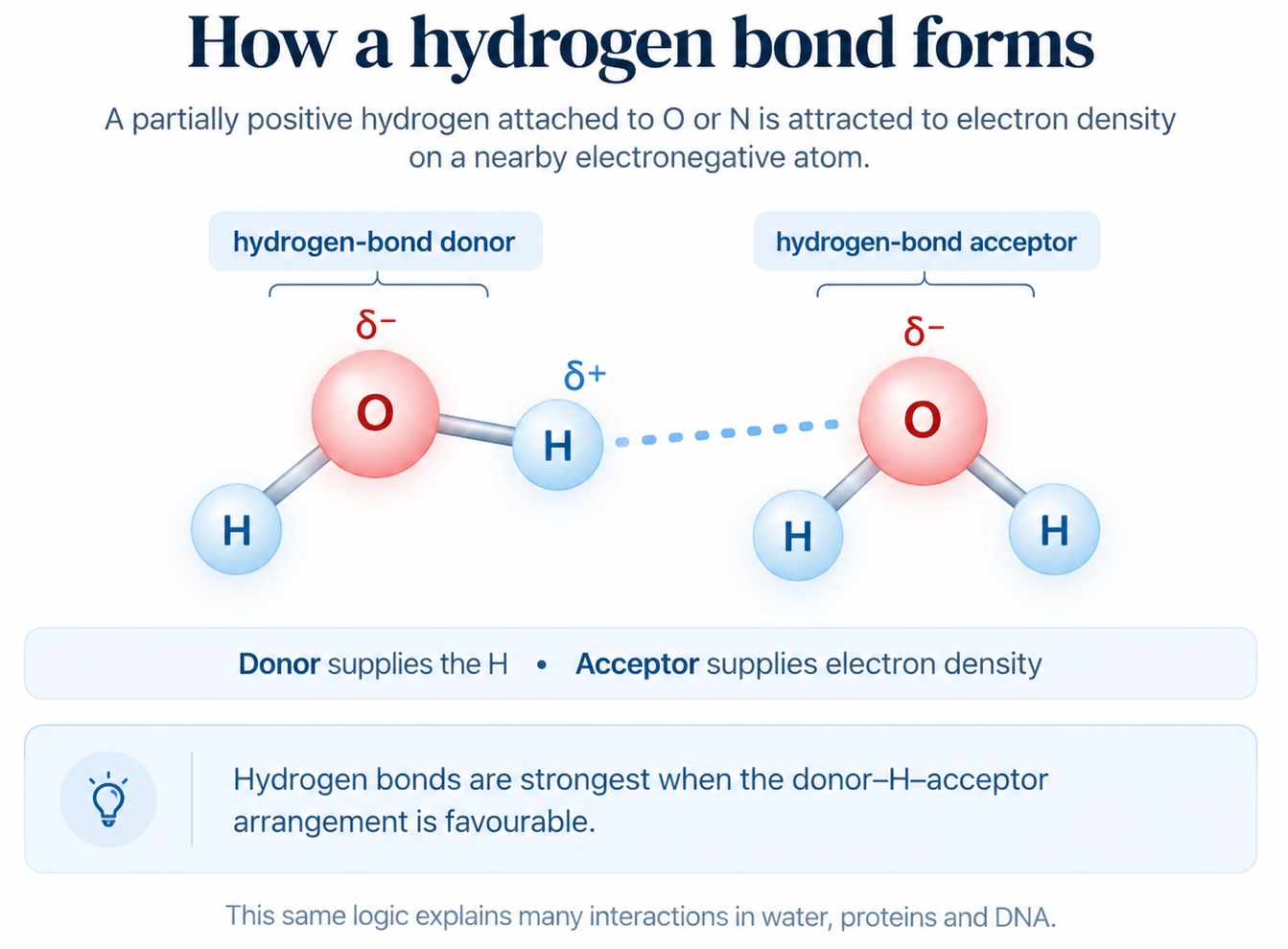
Donor and acceptor describe the two roles in a hydrogen bond
The donor provides the covalently attached hydrogen; the acceptor provides the electron-rich atom that attracts that partially positive H.
The donor contains the hydrogen that participates in the interaction. O–H and N–H groups are common biological donors because the attached H carries partial positive character.
The acceptor provides an electronegative atom with available electron density that can attract the δ+ hydrogen. Many oxygen atoms and some nitrogen atoms can act as acceptors, depending on their bonding context.
Donor does not mean “donates H⁺”. A hydrogen-bond donor presents a covalently attached H for the interaction. The hydrogen remains attached to its original atom; it is not being transferred as a proton.
Start with water because the mechanism is easy to see there
In one water molecule, an O–H group can provide the partially positive H. The oxygen of a neighbouring water molecule can provide electron density. The result is a hydrogen bond between the two molecules.
The same logic repeats in proteins, nucleic acids, carbohydrates and many other biomolecules. Find a suitable donor, find a suitable acceptor, then ask whether they can approach one another in the right geometry.
Distance and orientation determine whether the attraction is useful
A donor and acceptor do not form an equally favourable hydrogen bond from every position. They must be close enough, and the donor–H–acceptor arrangement must place the interacting groups in a suitable orientation. This is why molecular shape can decide whether a possible hydrogen bond actually contributes to binding or folding.
Why hydrogen bonds matter in biological structures
Water molecules hydrogen-bond with one another. Repeated hydrogen bonding helps explain cohesion and several unusual physical properties of water.
Hydrogen bonds form between complementary bases across the two strands and help make base pairing selective.
Backbone and side-chain hydrogen bonds help stabilise protein structure and can also contribute to molecular recognition at binding sites.
Why G–C-rich DNA is often harder to separate
In standard Watson–Crick pairing, A–T forms two hydrogen bonds and G–C forms three. An otherwise comparable G–C-rich region therefore has more inter-base hydrogen bonding to disrupt. That contributes to greater thermal stability, although base stacking, sequence and surrounding conditions also matter.
Hydrogen bonds arise from partial charges. Next, compare them with groups carrying full positive or negative charges, and then see how water changes the interaction.
Electrostatic interactions
Hydrogen bonding used partial charges: δ+ and δ− created when electrons are shared unequally in a covalent bond. Here, focus on a different case — atoms or molecular groups carrying afull net charge. Opposite full charges attract and like charges repel, but in cells the surrounding water strongly affects how much that interaction contributes.
Start from the charge you already know
Lesson 01 established the distinction: partial charges arise from unequal sharing inside polar covalent bonds, whereas a full charge means the atom or molecular group has a net charge such as +1 or −1. Here, the new question is what happens when two fully charged groups approach one another in a biological environment.
What do two full charges do?
A positive charge attracts a negative charge because the two charges have opposite signs. Two positive charges repel one another, and two negative charges repel one another. This is the simplest part of the mechanism — but it is only the starting point in Biology.
Do not stop at “opposites attract.” In a cell, charged groups are usually not interacting in empty space. They are surrounded by water, and water is itself polar.
What happens when a charged group is placed in water?
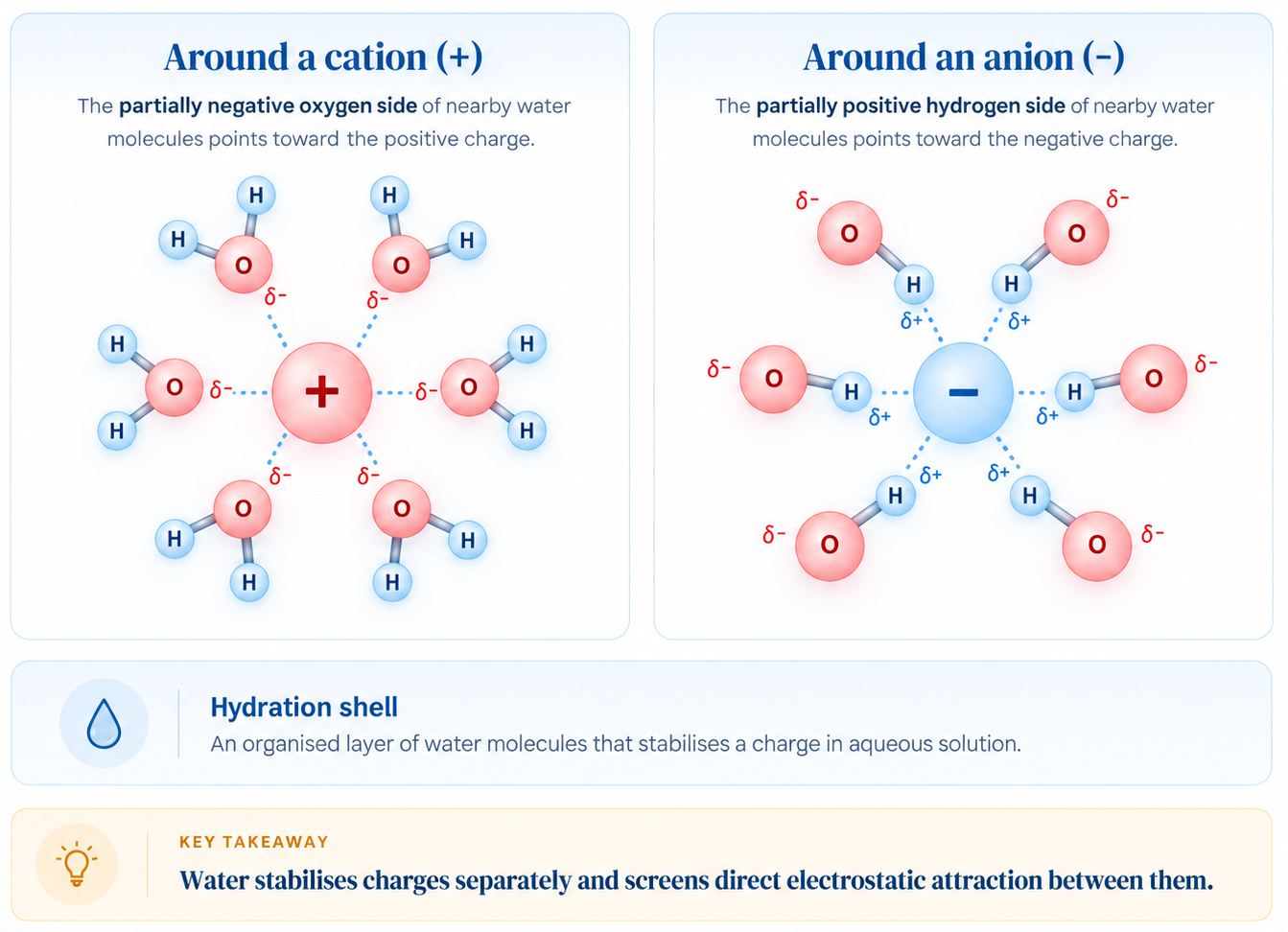
Think back to the polarity of a water molecule. Its oxygen carries partial negative character and its hydrogens carry partial positive character, so water orients differently around positive and negative charges. Many water molecules can organise around the same charged particle to form a hydration shell.
If water surrounds both charges, what happens to their attraction?
The opposite charges still attract — water does not reverse the rule. Instead, the surrounding water molecules screen the charges. They stabilise the ions individually and reduce how strongly the two charges interact directly with one another.
This is why the same positive and negative groups can contribute differently in different environments. In water, both charges are strongly solvated. In a less polar environment there is less solvent screening, so a formed, favourably positioned opposite-charge interaction can contribute more strongly. But burying an isolated charge without a suitable partner is energetically unfavourable.
Hydration shells surround charged groups. The solvent stabilises each charge and screens direct electrostatic attraction.
There is less hydration and less solvent screening. If opposite charges are already positioned favourably, their direct attraction can contribute strongly; an unpaired buried charge is unfavourable.
Now put the same idea inside a protein
Amino-acid side chains can carry full positive or negative charges. If an oppositely charged pair is positioned close enough, the attraction between them can help favour a particular protein arrangement. This close attraction between oppositely charged groups is commonly called a salt bridge.
A protonated amino group can carry a full positive charge, for example –NH₃⁺.
If a positive and negative side chain come close in a favourable position, their electrostatic attraction can help stabilise that local structure.
A deprotonated carboxyl group can carry a full negative charge, for example –COO⁻.
A salt bridge is therefore not a separate force. It is a biological example of electrostatic attraction between full opposite charges. Its contribution depends on distance, orientation, nearby charges and especially on how exposed the pair is to water.
Apply protonation to a salt bridge
Lesson 01 established that pH can shift protonation and therefore charge. Carry that idea forward: if one salt-bridge partner becomes neutral, the attraction that depended on two opposite full charges can weaken or disappear; if a like charge is introduced nearby, repulsion can appear instead.
Why can that change protein behaviour?
Imagine that a positive side chain and a negative side chain are helping to stabilise one region of a protein. If a change in pH causes one of those groups to become neutral, the attraction may disappear. If a new like charge appears nearby, repulsion may be introduced instead.
Creating or removing attractions and repulsions can favour a different local arrangement and alter the stability of the folded protein.
Charged groups often help molecules recognise and bind one another. Changing a key charge can weaken, strengthen or redirect that interaction.
If charged groups help shape an active site or participate in substrate binding, changing their protonation state can alter enzyme function.
If a question changes pH, a charged side chain or the surrounding environment, do not jump straight to “the protein denatures.” Follow the mechanism: charge changes → attraction or repulsion changes → then predict the structural or functional consequence.
Full charges make electrostatic attraction easy to recognise. But molecules can also attract one another even when they have no permanent charge at all. That leads to van der Waals forces.
van der Waals forces
Two atoms do not need a permanent charge to attract one another. Their electron clouds are constantly fluctuating, so the distribution of charge can become uneven for a brief moment. That temporary imbalance can influence a nearby atom and create a weak, short-range attraction. In biological discussions, van der Waals contacts describe weak interactions that become important when atoms approach favourable close distances; the attractive component can arise from transient fluctuations in electron distribution.
Start with the puzzle: how can neutral atoms attract?
A neutral atom has no overall charge, but that does not mean its electrons are frozen in a perfectly even arrangement. At any instant, slightly more electron density may happen to lie on one side of the atom than the other.
For that brief moment, one side has a little more negative character and the opposite side a little more positive character. This is a temporary dipole. It is not an ionic charge and it is not a permanent dipole — the electron distribution is continually changing.
One temporary dipole can create another nearby
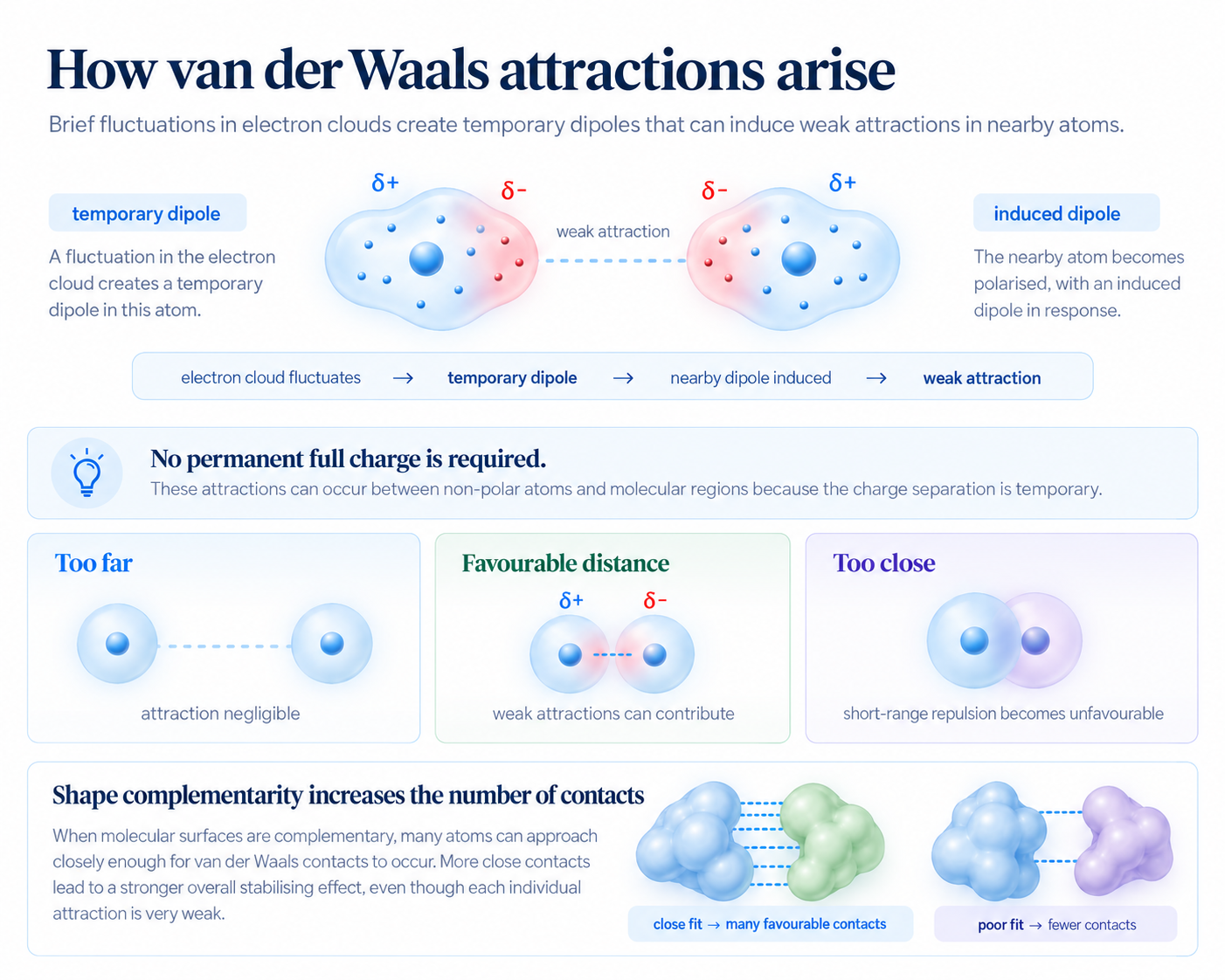
Suppose the side of atom A facing atom B becomes temporarily slightly negative. That electron-rich region can push the electrons in atom B slightly away. The near side of atom B then becomes relatively more positive, so the two neighbouring sides can attract.
The key sequence is therefore not “neutral atoms cannot interact.” It is: temporary unevenness in one electron cloud → induced unevenness in a nearby cloud → weak attraction.
Why many tiny contacts can still matter
The visual shows the distance rule: too far gives little attraction, while too close creates short-range repulsion. Biological molecules often exploit this narrow middle range. When two molecular surfaces fit well, many atoms can sit at favourable distances at the same time, so their individually tiny attractions can add up to meaningful stability.
A poorer fit leaves fewer atoms at favourable interaction distances. This is why shape complementarity, distance and packing can influence binding even when no covalent bond changes.
Where these contacts matter in Biology
van der Waals contacts contribute to tight packing inside proteins, contacts betweenmembrane lipids, base stacking in nucleic acids and the close fit between molecules at binding sites. The useful level here is not to calculate individual van der Waals forces, but to recognise when molecular shape, distance or packing increases or disrupts many weak contacts at once.
van der Waals forces explain how non-polar regions can make short-range attractive contacts. But in water, another effect becomes especially important: water itself favours the clustering of non-polar surfaces. This is the hydrophobic effect.
Hydrophobic effect
Non-polar molecules do not need to “repel” water in order to cluster. The key is what happens to water itself when a non-polar surface is placed in an aqueous environment.
Start with water, not with the hydrophobic molecule
Water molecules can form favourable hydrogen bonds with one another. Around a polar or charged group, water can also make favourable interactions with that group. A non-polar surface is different: it cannot form the same favourable interactions with water that polar or charged groups can.
Water can still surround the non-polar surface, but nearby water molecules have fewer favourable arrangements available. In this sense, the interfacial water becomes more constrained than water in the bulk solution.
Why clustering changes the situation
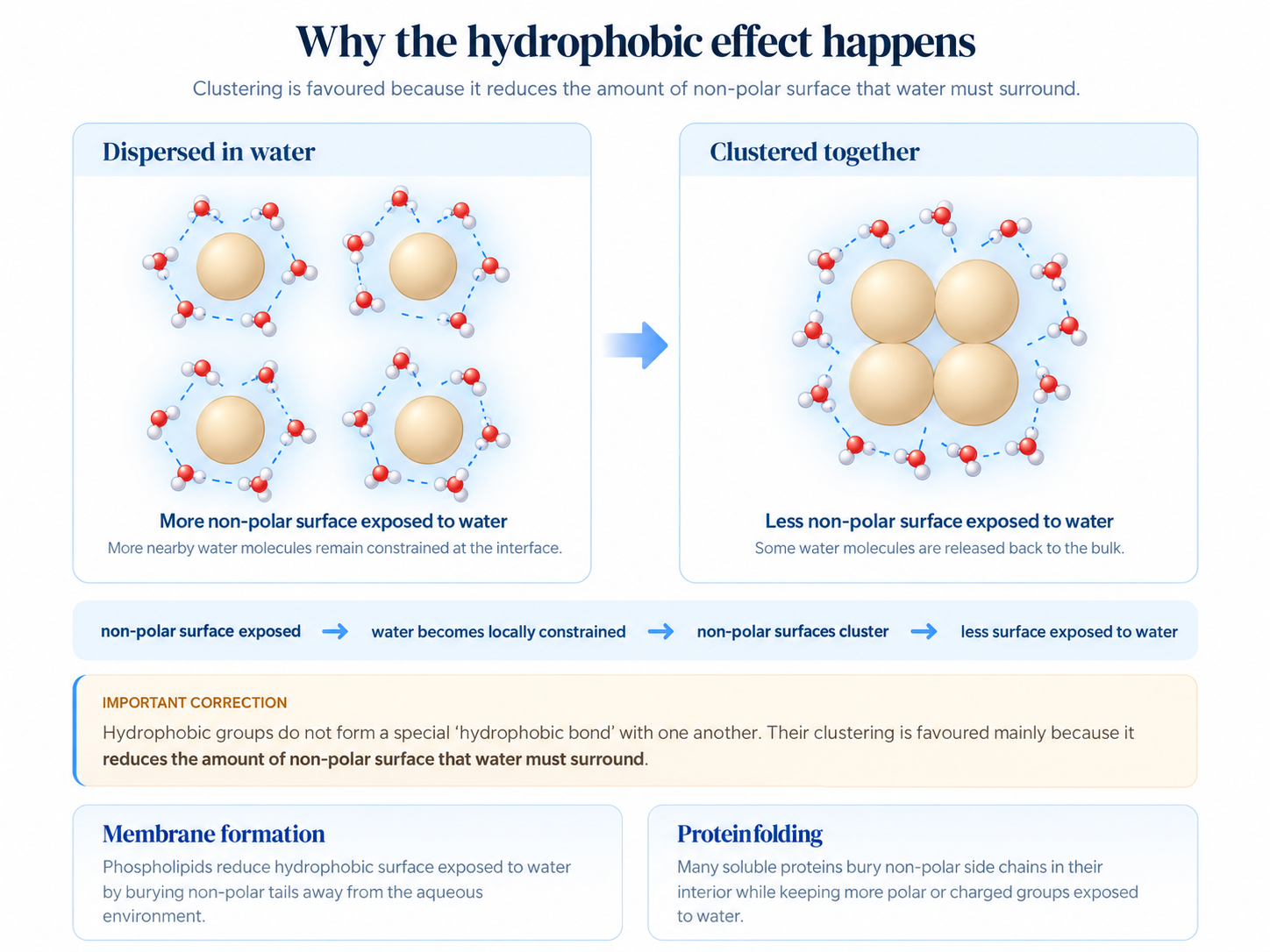
Imagine several small non-polar molecules dispersed separately in water. Each one exposes its own surface to the solvent, so a relatively large amount of water must remain organised around those separate surfaces.
If the non-polar molecules cluster together, some of those surfaces become buried against one another. The total non-polar surface exposed to water decreases, so fewer water molecules need to remain constrained at that interface. Some of those water molecules can return to the less constrained bulk solution.
This is why amphipathic molecules organise in water
An amphipathic molecule contains both a water-interacting region and a non-polar region. Phospholipids are the classic example: their hydrophilic, polar head groups interact favourably with water, while their hydrocarbon tails are hydrophobic and non-polar.
In water, phospholipids can self-organise so that their polar heads remain exposed to water while their non-polar tails cluster away from it. This reduces the amount of non-polar surface exposed to water and favours bilayer formation without requiring the tails to form any special “hydrophobic bond.”
Hydrophobicity belongs to the whole molecular pattern
“Contains carbon” is not enough to classify a molecule as hydrophobic. A molecule can contain many carbon atoms and still interact well with water if it also contains enough strongly polar or charged groups. What matters is the balance between non-polar surface and water-interacting regions.
A larger hydrocarbon region generally increases hydrophobic character, while polar or charged groups increase compatibility with water.
How to apply this idea
A common reasoning task is to predict what happens when the balance between polar and non-polar regions changes. If a hydrocarbon region becomes larger, a polar group is removed, or a non-polar side chain is moved into the protein interior, ask how much non-polar surface is exposed to water before and after the change.
The hydrophobic effect depends on the behaviour of water itself. Next, we bring together the properties that make water such an unusual biological solvent — including cohesion, temperature buffering, solvent behaviour and the structure of ice.
Water's biological properties
How can one small molecule help cool the body, carry dissolved ions, support a continuous column inside a plant and become less dense when it freezes? These properties look unrelated until you follow one molecular idea: polar water molecules continuously form and break hydrogen bonds with one another.
One hydrogen bond is temporary — a whole network changes the liquid
A single hydrogen bond between two water molecules is weak and short-lived. But each water molecule can interact with several neighbours, and those neighbours interact with others. The result is a constantly rearranging hydrogen-bond network.
That network is dynamic rather than rigid. Individual bonds break and reform all the time, yet at any moment many interactions are present across the liquid. The large-scale properties of water emerge from this collective behaviour.
Why do water molecules tend to stay together?
A water molecule at the surface is attracted to neighbouring water molecules beneath and beside it. Across the liquid, repeated hydrogen bonding creates cohesion — the tendency of water molecules to remain associated with one another.
At the surface this contributes to surface tension. In plants, cohesion helps keep water molecules connected as a continuous column through xylem. Water can also hydrogen-bond with many polar surfaces, so adhesion to the xylem wall can assist that upward movement.
Why is water slow to heat up?
Temperature reflects the average kinetic energy of molecules. When energy is supplied to liquid water, it does not simply make every molecule move faster immediately. Some of that energy is continually involved in disrupting and rearranging intermolecular hydrogen bonds.
Water therefore has a relatively high specific heat capacity: a substantial amount of energy can be absorbed or released while its temperature changes comparatively slowly. This helps stabilise the temperature of cells, organisms and aquatic environments.
Why does evaporation cool a surface?
Molecules in a liquid do not all have the same kinetic energy. The higher-energy molecules are more likely to escape from the surface as vapour, but doing so also requires them to overcome attractions to neighbouring water molecules.
When those higher-energy molecules leave, they carry energy away and the average kinetic energy of the water left behind falls. That is why sweating cools the body and why transpiration can cool a leaf.
Heating and evaporation are related but not identical. During heating, energy is absorbed while the hydrogen-bond network is continually rearranged. During evaporation, molecules that escape carry energy away from the liquid.
Why can water carry ions and polar molecules?
Water has partial charges: oxygen is δ− and the hydrogens are δ+. Those partial charges can orient around ions and polar groups, allowing favourable interactions between the solute and surrounding water.
This helps many ions and polar molecules remain dispersed in solution, which is why water works so well as a medium for transport and biochemical reactions. Blood plasma, cytosol and other biological fluids can therefore carry dissolved ions and many polar metabolites.
Section 03 showed the local picture: water molecules form hydration shells around charged groups. Here the larger consequence is the important one — many biologically useful solutes can stay dissolved and move through aqueous environments.
Why does ice float when most solids sink?
In liquid water, hydrogen bonds are constantly breaking and reforming, so molecules can move past one another and pack relatively closely. When water freezes, hydrogen bonding holds the molecules in a more open, ordered arrangement that spaces them farther apart on average.
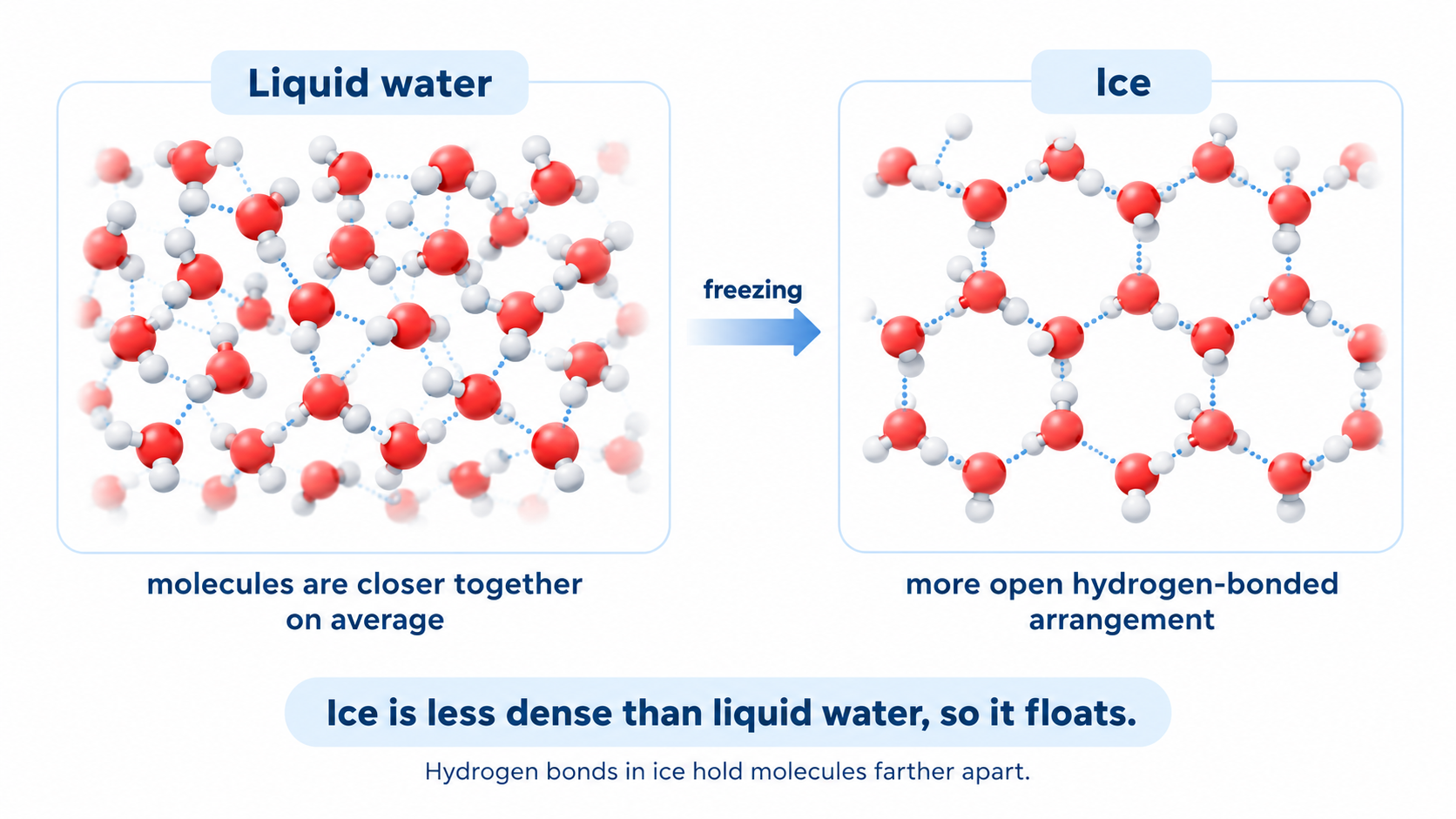
The same mass therefore occupies a larger volume in ice, making ice less dense than liquid water. Ice floats and forms first at the surface, so liquid water can remain beneath it. That helps aquatic environments remain habitable during cold conditions.
Do not memorise “water is special” as a list. Start with polarity, then follow the mechanism: hydrogen bonding changes cohesion, heat behaviour, evaporation and the structure of ice; polarity also makes water an effective solvent for many ions and polar molecules.
You now have the main interaction tools: hydrogen bonding, electrostatics, van der Waals contacts, the hydrophobic effect and the behaviour of water. The final section combines them so you can decide which interaction matters most in an unfamiliar biological situation.
Apply the reasoning
At this point, the goal is not to name every weak interaction in a molecule. It is to notice what changed, identify the interaction most directly affected, and then predict the biological consequence.
A useful question is: what is different before and after? A charge may disappear, a non-polar surface may become exposed, two groups may move farther apart, or a donor/acceptor may be lost. The interaction follows from that change.
Example · A buried non-polar side chain is replaced by a charged one
This is not just a vocabulary question about “hydrophobic” versus “charged.” Think about the original environment. A non-polar side chain can be favourable inside a hydrophobic protein core because little non-polar surface is exposed to water and nearby atoms can pack closely.
Replacing that group with a charged side chain changes several things at once. The new side chain interacts strongly with water, may no longer be comfortable in the non-polar interior, and may disrupt the local packing that previously stabilised the fold.
Sometimes more than one interaction contributes
Biological structures are usually stabilised by several effects at once. A DNA duplex, for example, depends on selective hydrogen bonding between complementary bases, but base stacking and other short-range interactions also contribute to stability.
So if a question says a DNA region becomes richer in G–C pairs, it is reasonable to connect the change to the extra hydrogen bond in each G–C pair under comparable conditions — while remembering that hydrogen bonds are not the only contribution to duplex stability.
More G–C pairs means more inter-base hydrogen bonding than the same number of A–T pairs.
The region is generally harder to separate under comparable conditions, without claiming that hydrogen bonds are the only force involved.
Shape can matter even when the chemical groups stay the same
A ligand may contain the same donor, acceptor, charged and non-polar groups as before but bind less strongly after its shape changes. The reason is geometric: those groups may no longer reach the right positions, and fewer atoms may sit at favourable short-range distances.
Also ask whether those groups are close enough and oriented correctly to interact. Chemistry creates the possibility; geometry determines whether the interaction can actually contribute.
Use the environment to resolve close calls
If two answer choices both sound chemically possible, the surrounding environment often decides which one makes more sense. A charged group exposed to water behaves differently from the same group buried inside a non-polar region. A non-polar surface in water behaves differently from one already buried inside a protein or membrane.
Charge, polarity, non-polar surface, distance, orientation or solvent exposure?
Hydrogen bonding, electrostatics, short-range packing or the hydrophobic effect?
Does it favour association, weaken packing, alter folding or change solubility?
Follow the mechanism before jumping to a dramatic outcome such as complete denaturation.
At this level, focus on the mechanism and biological consequence of these interactions. You do not need quantum-mechanical derivations, dielectric equations or molecular-dynamics calculations.