
BIOLOGY · FOUNDATIONS · LESSON 01
Molecular foundations of living systems
Membranes keep some substances out. Proteins fold into precise shapes. Enzymes recognise some molecules and ignore others. These behaviours begin with a small set of molecular ideas: charge, polarity, shape and the way molecular groups interact with their surroundings. This lesson builds those ideas from first principles so unfamiliar biological structures become readable, not something you have to memorise by appearance.
JUMP TO SECTIONElements, atoms & ions1/7
Elements, atoms & ions
Cells are built from ordinary matter. The carbon, oxygen, sodium and other elements inside a living cell are the same elements found outside it. What makes their biological roles different is how their atoms are arranged, bonded and charged. That is where this lesson begins: with the smallest molecular clues that Biology keeps using again and again.
From elements to biological molecules
An element is a type of atom, such as carbon or oxygen. An atom is one particle of that element. When atoms become joined by covalent bonds, they can form molecules. Water, glucose and DNA are therefore very different molecules built from combinations of ordinary atoms.
Why do the same few elements appear again and again in Biology?
Living systems make heavy use of carbon, hydrogen, nitrogen, oxygen, phosphorus and sulfur. The value of these elements is not simply that they are present; it is that they can be combined into stable structures with useful patterns of charge, polarity and shape.
Carbon forms molecular frameworks; hydrogen and oxygen make up water and occur in many polar groups; nitrogen appears in amino acids and nucleic-acid bases; phosphorus is central to nucleotides, ATP and phospholipids; and sulfur occurs in amino acids such as cysteine and methionine.
Some elements are required in smaller amounts but remain biologically essential. Iron is needed in haem-containing proteins, while iodine is required for thyroid hormones. This is an important Biology idea: small quantity does not mean small importance.
What changes when an atom or molecular group becomes charged?
Atoms contain positively charged protons and negatively charged electrons; neutrons, when present, are uncharged. A neutral atom has equal numbers of protons and electrons. If an atom loses electrons, it becomes positively charged; if it gains electrons, it becomes negatively charged. A whole atom or molecule with a net charge is an ion. Within larger biological molecules, particular functional groups can also carry charge, and some of those groups can change charge by gaining or losing H⁺.
You do not need electron-configuration calculations here. What matters for Biology is the result: an ion carries a full electrical charge, and that charge changes how it behaves in water, near membranes and around charged regions of proteins.
Has a net positive charge. Na⁺, K⁺ and Ca²⁺ are important biological examples.
Has a net negative charge. Cl⁻ is a common biological example.
Why do cells care so much about ions?
Ions are not just dissolved particles. Cells keep different ion concentrations on different sides of membranes. Those gradients can store potential energy, influence water movement and allow electrical signalling.
For example, Na⁺ and K⁺ gradients are central to membrane potentials, Ca²⁺ can act as an intracellular signal, and Cl⁻ contributes to charge balance and transport. These ions have different biological roles, but they share one important feature: full electrical charge gives them distinctive behaviour in water and across membranes.
Ions do not readily cross the hydrophobic lipid core by simple diffusion. Cells use selective channels and carriers to control ion movement, while energy-coupled pumps and other active transport systems can build and maintain ion gradients.
Full charge explains ions, but most biological molecules are not ions from end to end. Their behaviour often depends on smaller regions of unequal charge. To understand those regions, the next step is to look at how electrons are shared inside covalent bonds.
Polarity, charge & water
Water surrounds almost every molecule in a cell, yet some molecular regions mix readily with it while others avoid it. The difference begins inside covalent bonds: electrons are shared, but they are not always shared equally.
Why covalent bonds can still create polarity
In a covalent bond, atoms share electrons. These bonds form the strong frameworks of biological molecules: the carbon skeleton of a fatty acid, the backbone of a protein and the bonds within a sugar are all covalent.
The important next question is not merely “is the bond covalent?” It is: are the shared electrons distributed evenly?
Unequal sharing creates partial charges
Some atoms attract shared electrons more strongly than others. Oxygen and nitrogen, for example, pull shared electrons more strongly than hydrogen. When this happens, one end of the bond becomes slightly more negative and the other slightly more positive.
These are written as δ− and δ+. They are called partial charges because the atoms have not become full ions; the electrons are still being shared in the covalent bond.
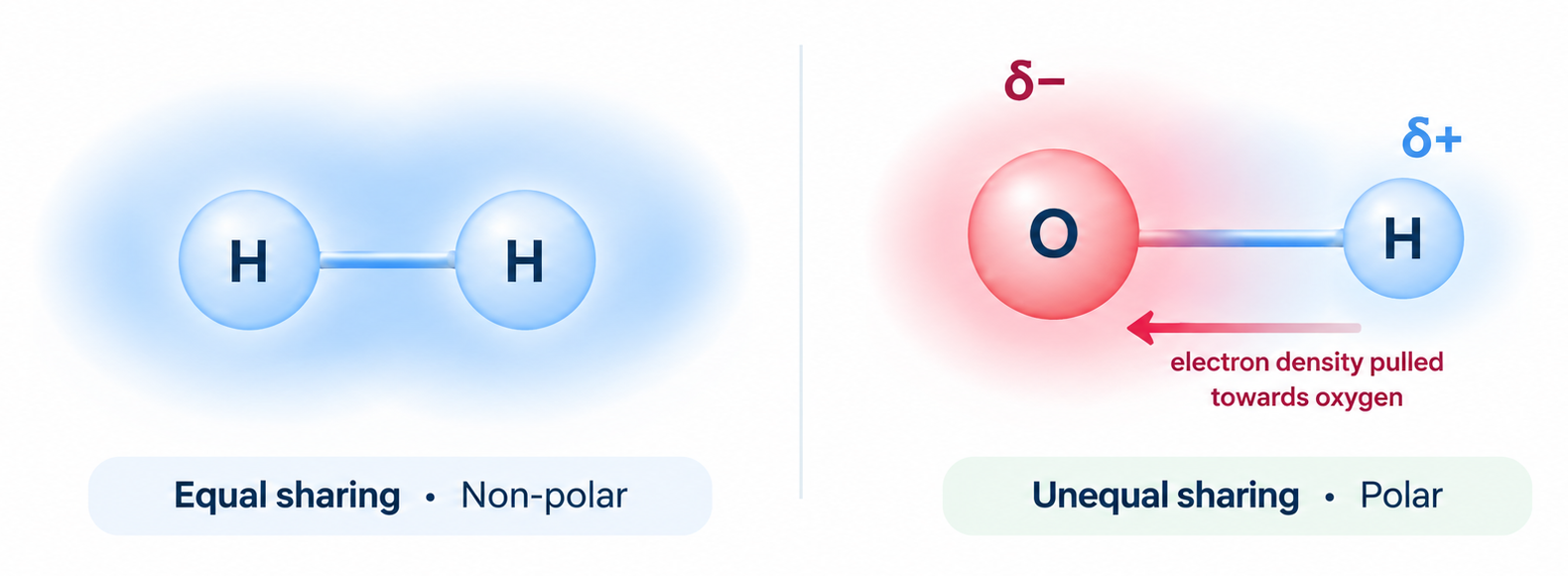
Polar O–H bonds make water a polar molecule
In each O–H bond, oxygen attracts the shared electrons more strongly than hydrogen. The oxygen side therefore develops partial negative character while the hydrogen sides develop partial positive character. Water also has a bent shape, so these partial charges do not cancel one another. The molecule has no overall charge, but its charge is distributed unevenly — making water polar.
This distinction matters: a molecule can contain polar bonds without necessarily being polar overall; the arrangement of those bonds also matters. In water, the bent arrangement leaves a clear partially negative region near oxygen and partially positive regions near the hydrogens.
A polar water molecule can therefore orient itself around charged or polar regions of other molecules. This is one molecular reason some substances interact readily with water while others do not.
A group has a net electrical charge, such as +1 or −1. Ions and ionised functional groups behave this way.
Electrons are shared unequally in a covalent bond, producing δ+ and δ− regions without creating a full ion.
How does polarity change water interaction?
Polar and charged regions can form favourable interactions with water, so they are described as hydrophilic. Large regions made mainly from C–C and C–H bonds have much less charge separation and interact poorly with water; these regions are hydrophobic.
This is not an all-or-nothing classification. A single molecule can contain both kinds of region. The balance between them often matters more than any one bond viewed in isolation.
Phospholipids show why the whole-molecule view matters
A phospholipid has a hydrophilic head region containing strongly polar or charged groups and hydrophobic hydrocarbon tails. The head interacts favourably with water, whereas the tails interact poorly with it. Because both kinds of region occur in the same molecule, phospholipids are amphipathic.
That mixed character is not just vocabulary. It tells you that different parts of the same molecule interact differently with water. Lesson 02 will explain the physical mechanism that makes amphipathic molecules self-organise into bilayers.
Polarity tells you how a region interacts with its surroundings. But molecules also occupy space. The way carbon atoms are arranged can change shape, packing and recognition — even when the same kinds of atoms are present.
Carbon skeletons & shape
Two biological molecules can contain the same kinds of atoms and still behave differently because shape matters. Carbon can build chains, branches and rings, and bonding within those frameworks can introduce bends that change how molecules pack, fit and interact.
Carbon skeletons create different molecular frameworks
A carbon atom can form four covalent bonds, including bonds to other carbon atoms. This allows carbon atoms to connect repeatedly. The result can be a straight chain; a carbon atom can also connect to more than two other carbon atoms to create a branch, or a chain can close to form a ring. These arrangements are called the molecule's carbon skeleton.
Why are long hydrocarbon regions usually hydrophobic?
A region made mainly from C–C and C–H bonds has very little separation of charge. Water is polar, so it interacts much more favourably with charged or strongly polar groups than with a long hydrocarbon surface. As the non-polar carbon region becomes larger, the molecule usually becomes more hydrophobic unless enough polar or charged groups are also present.
This is why fatty-acid tails behave so differently from the polar heads of phospholipids, and why hydrophobic regions later become important in membrane interiors and protein folding.
Single and double bonds can change the shape of the skeleton
A carbon–carbon single bond allows rotation around the bond, whereas rotation around a C=C double bond is restricted. This fixed arrangement is what makes different geometric forms, such as cis and trans, possible.
A fatty acid with no C=C double bonds is saturated. A fatty acid containing one or more C=C double bonds is unsaturated.
In a cis double bond, the carbon-chain segments lie on the same side of the double bond, producing a bend in the chain. In a trans double bond, they lie on opposite sides, so the chain remains much straighter.
That difference in shape matters biologically because it changes how closely neighbouring fatty-acid tails can pack. Cis-unsaturated tails pack less tightly and therefore tend to increase membrane fluidity, while straighter saturated or trans-unsaturated tails can pack more closely.
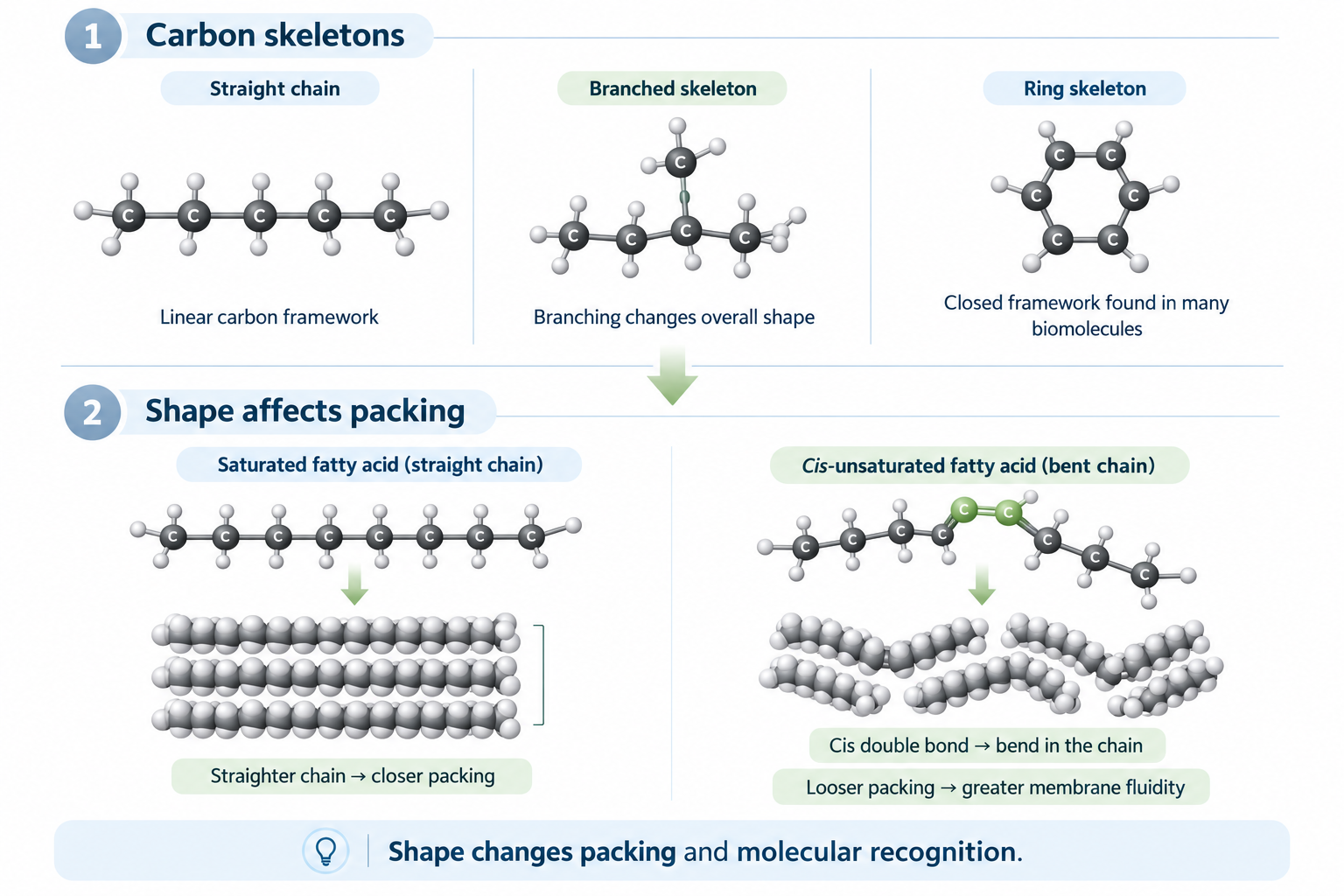
Why does shape matter beyond membranes?
Biological molecules often work because they fit another molecule. An enzyme must position a substrate correctly; a receptor must recognise a ligand; a transport protein must distinguish between different molecules or ions. Two molecules can therefore contain similar atoms but behave differently if those atoms are arranged into different three-dimensional shapes.
Use shape as evidence: carbon arrangement changes shape, and shape can change packing, recognition and function.If a structural change alters how closely molecules fit or pack, that can be enough to predict a biological consequence.
Shape changes packing. A cis double bond introduces a bend, so neighbouring fatty-acid tails cannot pack as tightly. This is why a small structural change can influence membrane fluidity without changing the molecule into a charged species.
Carbon provides the framework. Small groups attached to that framework can add polarity, charge or new interaction sites. Those functional groups are often what make two otherwise similar molecules behave very differently.
Functional groups
Add one –OH, –COO⁻ or –NH₃⁺ group to a carbon framework and the molecule may interact with water, membranes or other molecules very differently. Functional groups matter because they place specific chemical properties at specific positions on the molecular skeleton.
Functional groups give the carbon skeleton new properties
A functional group is a recurring arrangement of atoms that contributes a recognisable property to a molecule. In Biology, the useful question is not simply “what is this group called?” but what does this group add to the molecule?
A group may add polarity, a possible charge or a site that can make favourable interactions with other molecules. These local properties can change how that part of the molecule behaves in water or near other molecular groups. The effect of one functional group must still be interpreted in the context of the whole molecule.
POLAR, USUALLY UNCHARGED GROUPS
Hydroxyl and carbonyl groups add polarity
A hydroxyl group, –OH, contains polar O–H and C–O bonds. That polarity allows hydroxyl groups to make favourable interactions with water, so several –OH groups can make a carbon-based molecule strongly hydrophilic. Glucose is a good example of how several polar groups can strongly influence the behaviour of the whole molecule.
A carbonyl group, C=O, is also strongly polar because electron density is drawn toward oxygen. Carbonyl groups occur in many sugars and metabolic intermediates, where their polarity helps influence how those molecules interact and react.
GROUPS THAT CAN CARRY CHARGE
Carboxyl, amino and phosphate groups can create strongly charged regions
A carboxyl group can lose H⁺ and become –COO⁻. A negatively charged carboxylate interacts strongly with water and is attracted to positively charged regions. Carboxyl groups occur in amino acids, fatty acids and many metabolic molecules.
An amino group can gain H⁺ and become –NH₃⁺. The positive charge changes how the group interacts with water and with negatively charged regions. These charge patterns later help explain why particular parts of proteins attract, repel or recognise other molecular groups.
Phosphate-containing groups are strongly polar and commonly negatively charged in cells. Phosphate appears in ATP, nucleotides, DNA and RNA backbones, phospholipids and many regulated proteins. Adding or removing phosphate can therefore change charge and molecular interactions.
The charge of some functional groups is not fixed. Changes in H⁺ availability can shift a group between differently charged forms, which can change the interactions that region of the molecule can make.
STRUCTURE AND RECOGNITION
Sulfhydryl and methyl groups affect molecules in different ways
A sulfhydryl group, –SH, occurs in cysteine. Two cysteine side chains can form a covalent disulfide bond between their sulfur atoms. These cross-links can help stabilise the folded structure of a protein.
A methyl group, –CH₃, is non-polar. Adding a methyl group can alter molecular shape, hydrophobic character and recognition without introducing a charge. Methyl groups also appear in regulatory modifications of DNA and proteins.
Why can one functional group change the behaviour of the whole molecule?
Functional groups change where polarity and charge are concentrated. Several hydroxyl groups can increase water interaction; phosphate can introduce strong negative charge; carboxyl and amino groups can change charge; and a methyl group can make part of a molecule more hydrophobic. The final behaviour depends on the combined pattern of the carbon skeleton and all of the attached groups.
Now look at the groups together. The aim is to recognise each structural pattern and connect it to the property you have just learned — polarity, charge or non-polar character.
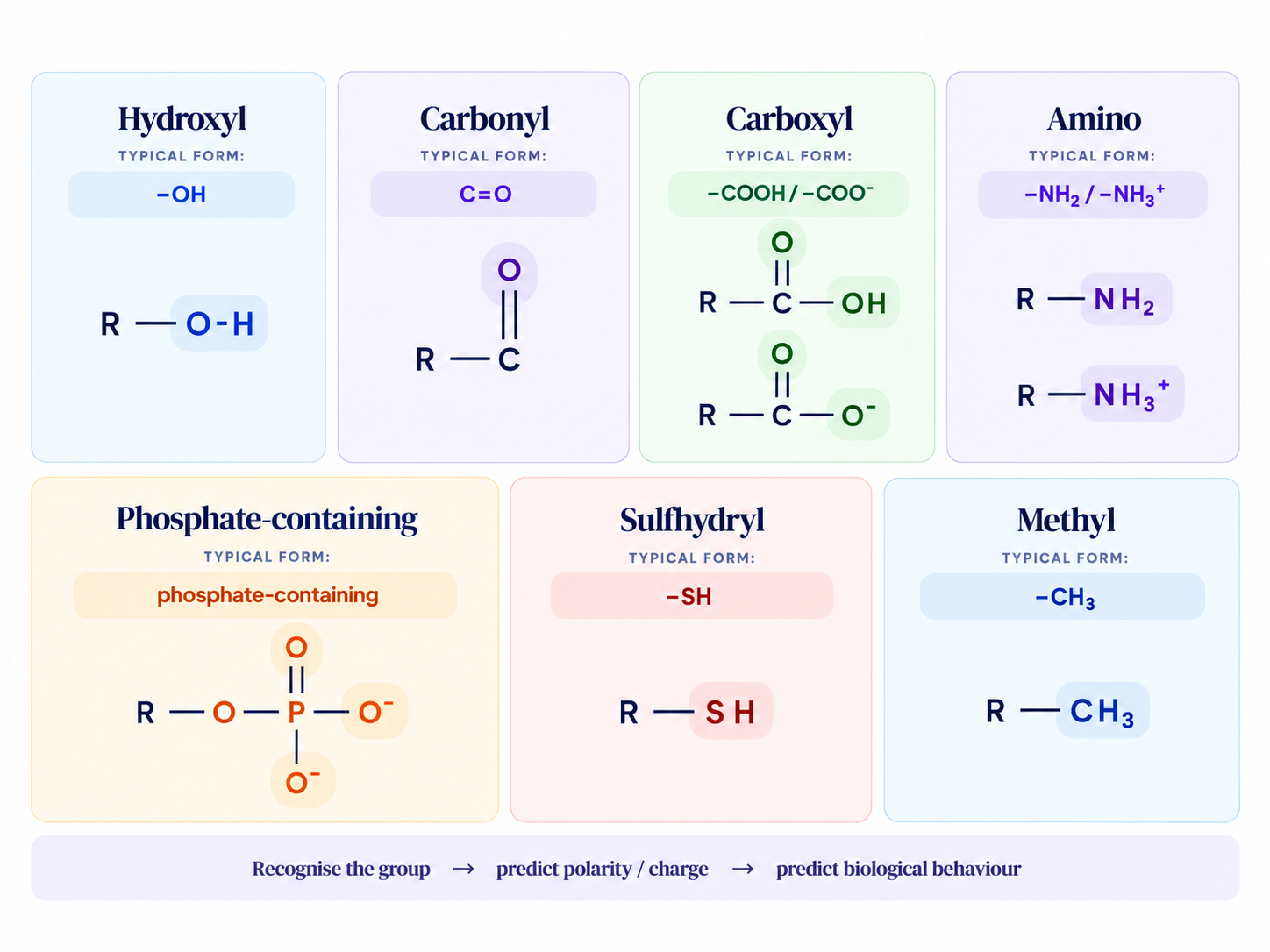
Full charge gives the strongest clue for interaction with water. A –COO⁻ region is charged, –OH is polar, and –CH₃ is non-polar. When you meet an unfamiliar molecule, use those properties before trying to recognise the molecule by name.
You can now read many of the important features on a molecule. The next step is dynamic: cells must build larger molecules from smaller components — and later break those links again when molecules are digested, recycled or remodelled.
Building & breaking biomolecules
A cell cannot function with building blocks alone. Amino acids must become proteins, nucleotides must become nucleic acids, and stored molecules must later be broken down again. Across these very different systems, one structural idea keeps returning: forming covalent links builds; breaking them dismantles.
Building and breaking are opposite molecular processes
In a condensation reaction, smaller units are joined while a small molecule is removed, commonly water. In hydrolysis, water is used while a covalent bond is broken.
The important Biology idea is directional: condensation helps build larger biological structures, whereas hydrolysis helps break them into smaller units. Digestion is full of hydrolysis reactions because large food molecules must be broken before their smaller components can be absorbed or reused.
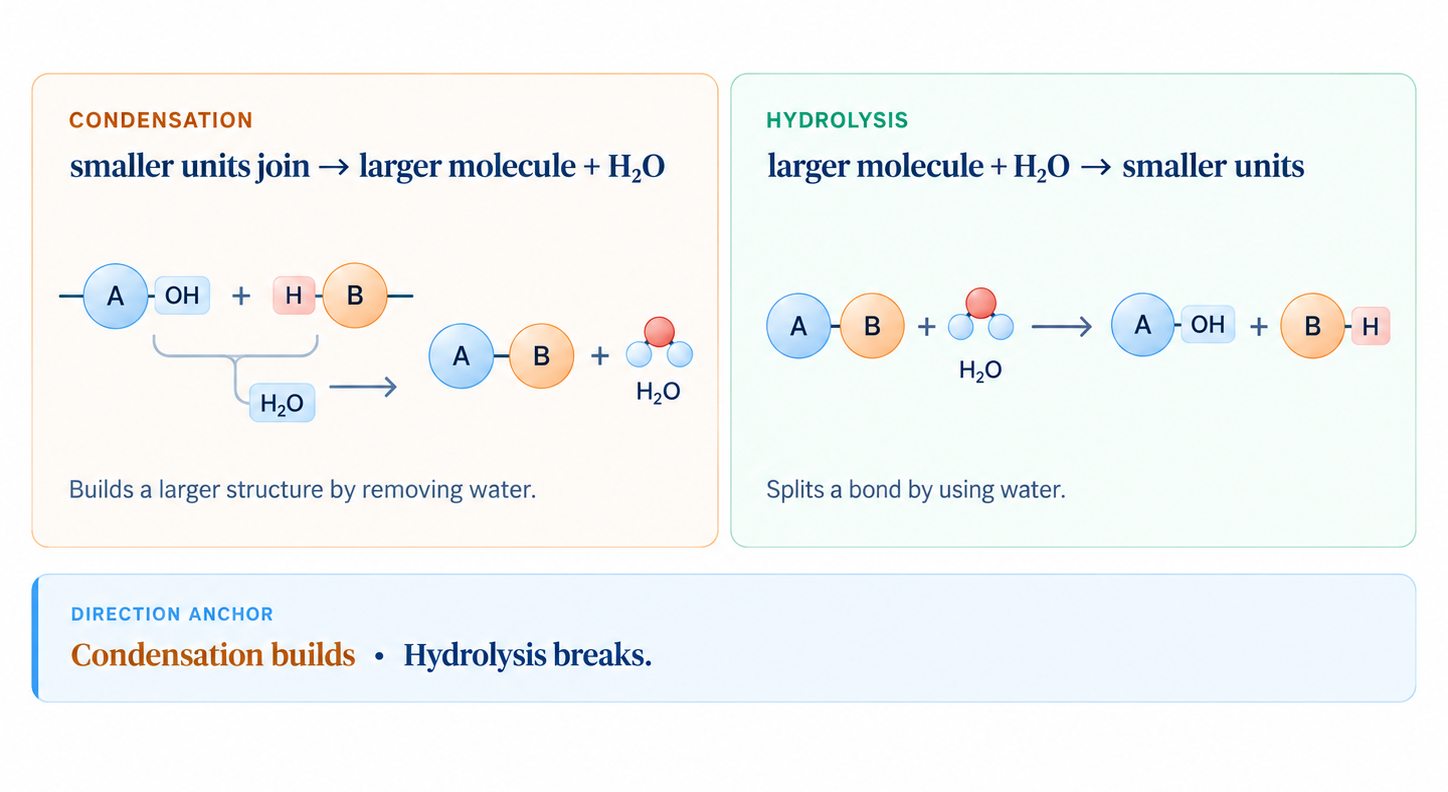
Different building blocks form characteristic covalent links
The type of covalent link depends on the building units being joined. The map below connects the main biological building blocks with the bonds they form, so you can begin to recognise how a larger molecule has been assembled.
Builds the polypeptide chain of a protein.
Builds disaccharides and polysaccharides.
Links glycerol and fatty acids in many lipids.
Forms the sugar–phosphate backbone of DNA and RNA.
Monomer and polymer describe a pattern of construction
A monomer is a smaller molecular subunit that can be linked with other monomers. A polymer contains many covalently linked monomer units. Proteins are polymers of amino acids, nucleic acids are polymers of nucleotides, and polysaccharides are polymers of monosaccharides.
Lipids are a major class of biological molecules, but most are not true polymers. A triacylglycerol, for example, is assembled from glycerol and fatty acids rather than from a long chain of repeating monomer units. So the statement “all large biological molecules are polymers” would be too broad.
The useful pattern is simple: different building units form characteristic covalent links. Those bond names will become useful clues when you read the structures of carbohydrates, lipids, proteins and nucleic acids.
Condensation and hydrolysis alter covalent links. But Biology also uses a subtler kind of change: a functional group can gain or lose H⁺, changing its charge — and therefore its interactions — while the molecule's main covalent skeleton stays intact.
pH, protonation & charge
Change the pH around a protein and its covalent backbone may remain intact, yet its behaviour can change. The reason is that some functional groups can gain or lose H⁺. If that changes their charge, it can also change the interactions that help determine folding, binding and enzyme activity.
pH changes the availability of H⁺
pH is a measure related to the concentration of H⁺ in solution. A lower pH means the solution contains a higher concentration of H⁺, while a higher pH means the H⁺ concentration is lower. The pH scale is logarithmic, but the first biological idea to understand is simply the direction: changing pH changes the availability of H⁺ around a molecule.
The surrounding solution therefore affects groups that are able to gain or lose a proton. pH does not directly “put a charge” onto the whole molecule. Instead, it changes which protonation stateof a particular group is favoured.
What does protonation actually mean?
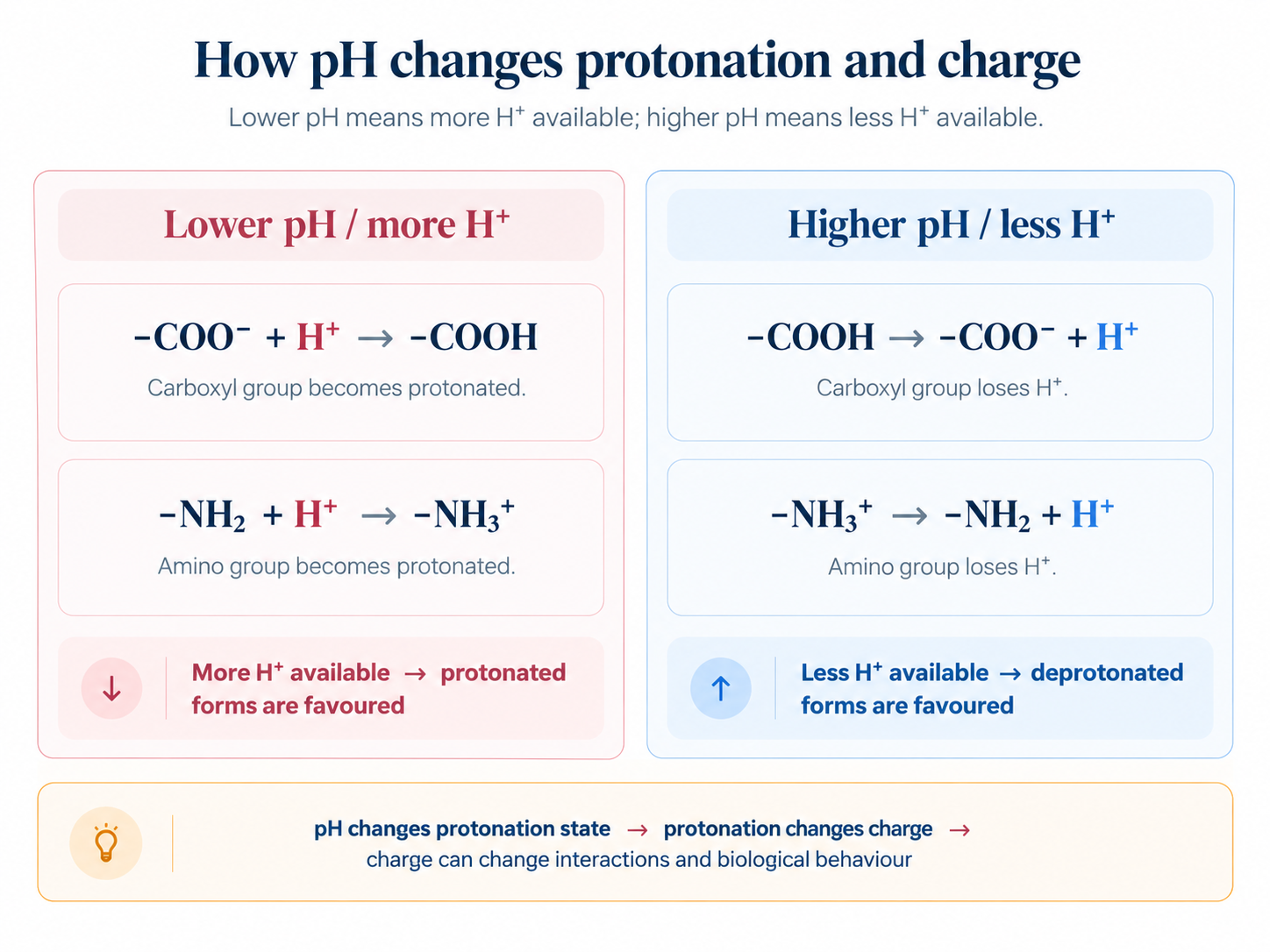
Protonation means gaining H⁺. Deprotonation means losing H⁺. Because H⁺ carries one positive charge, exchanging a proton changes the charge of the group by one unit. The result depends on the group you started with, which is why different functional groups respond to pH in different ways.
Carboxyl groups show how losing H⁺ can reveal a negative charge
A carboxyl group can be written as –COOH. In this form, the group is neutral overall. If the –OH part loses H⁺, the group becomes –COO⁻. The carbon skeleton has not been rebuilt and no covalent backbone has been broken; the important change is that the group now carries a full negative charge.
This is why higher pH conditions, where H⁺ is less abundant, tend to favour the deprotonated –COO⁻ form of a carboxyl group. Lower pH conditions tend to favour the protonated –COOH form.
Amino groups show a different charge change
An amino group can be written as –NH₂. The nitrogen can accept H⁺, producing –NH₃⁺. In this case, protonation changes a neutral group into a positively charged one. Lower pH therefore tends to favour the protonated –NH₃⁺ form, while higher pH makes the deprotonated –NH₂ form more favourable.
Notice the important difference: protonation does not give every group the same final charge. A carboxyl group moves between neutral and negative forms; an amino group moves between neutral and positive forms. You must understand the group before you can predict the charge.
pH shifts a balance; it does not act like an on–off switch
In a real solution, protonated and deprotonated forms can exist in equilibrium. Changing pH shifts the balance toward one form or the other. The exact balance depends on the chemical group and its local environment, so it is better to think in terms of one form becoming more favoured rather than imagining that every molecule changes charge at exactly the same pH.
To reason through a pH change, first decide whether the environment has become more acidic or more alkaline. Then identify the group that can gain or lose H⁺ and work out which protonation state — and therefore which charge — becomes more favoured.
Why does changing one charge matter inside a protein?
A charged side chain interacts differently from a neutral one. Charge changes how strongly a group interacts with water and whether it is attracted to or repelled by nearby charged groups. If a protein depends on a particular positive–negative attraction, removing one of those charges can weaken that interaction even though the protein's covalent backbone is still intact.
For example, imagine a positively charged group positioned near a negatively charged carboxylate. If the carboxylate gains H⁺ and becomes neutral –COOH, the attraction between the oppositely charged groups is reduced. That local change can alter folding, the shape of a binding site or the way two molecules recognise one another.
This is one reason enzyme activity depends on pH
Enzyme active sites often contain amino-acid side chains that must have particular charges to bind a substrate or take part in catalysis. If pH changes their protonation state, those groups may no longer interact with the substrate in the same way. pH can also alter interactions elsewhere in the protein and therefore change the shape of the active site.
This does not mean that every change in pH instantly destroys an enzyme. It means that each enzyme works best over a range in which the important groups have suitable protonation states and the protein retains the structure needed for its function.
From pH change to biological consequence
Follow the chain of reasoning: a change in pH changes H⁺ availability; this can shift the protonation state of particular functional groups; protonation can change charge; and charge can then change water interaction, attraction or repulsion between groups, protein folding, binding or enzyme activity.
Full charge, partial charge, polarity, shape, functional groups, covalent links and protonation are no longer separate facts. The final section combines them so you can reason from an unfamiliar structure to a biological prediction.
From structure to function
By this point, an unfamiliar structure should no longer feel like a naming test. It is a set of clues. Read those clues, decide what molecular properties they create, place the molecule in its biological environment, and you can often predict what it will do before you ever know its name.
Read the visible structural clues first
Several –OH groups suggest a strongly polar region. A full charge such as –COO⁻ suggests very favourable interaction with water. A long region made mainly from C–C and C–H bonds suggests hydrophobic character. A cis double bond can change shape and packing. Each of these features is evidence.
The first useful question is therefore not “What is this molecule called?” but “What property follows from the structure I can see?”
The environment changes what a structural clue means
A charge is strongly stabilised in water but is poorly suited to the non-polar centre of a lipid bilayer. Inside a protein, the same charge may attract an opposite charge or repel a like charge. A structural clue becomes biologically useful only when you consider what surrounds it.
Read the whole molecule, not one group in isolation
Many biological molecules contain both polar and non-polar regions. A phospholipid, for example, has a water-interacting head and hydrophobic tails. Its behaviour comes from the combination of those regions. This is why one true observation should not automatically determine the behaviour of the entire molecule.
1 carboxylate (–COO⁻)
Short carbon chain
–OH groups → polar
–COO⁻ → full negative charge
Carbon chain → non-polar region
The polar and charged regions dominate, so the molecule would be expected to be strongly hydrophilic.
Favourable in an aqueous environment. Simple diffusion through the hydrophobic core of a lipid bilayer is unlikely.
Notice that the molecule never had to be recognised by name. The prediction came from combining the visible features and weighing which properties dominate.
Small molecular changes can produce larger biological effects
Imagine that a negatively charged protein side chain becomes neutral after gaining H⁺. A nearby charge-dependent attraction may weaken. That local change can alter folding, ligand binding or the geometry of an enzyme active site even though the protein's covalent backbone remains intact.
The same reasoning applies to shape. A cis double bond bends a fatty-acid chain, reduces tight packing and can therefore contribute to greater membrane fluidity. Molecular structure matters because it changes the interactions a molecule can make.
Use the same reasoning with an unfamiliar structure
A new structural formula may look unfamiliar, but the reasoning stays the same. Identify the relevant clue, determine what property it changes, and connect that property to the biological environment. The molecule's name is often less useful than the visible charge, polarity, shape and functional groups.
If several options contain true statements, prefer the one that follows most directly from the evidence provided. Do not add assumptions that the question has not given you.
These ideas will keep returning throughout Biology
Atoms provide the building material. Unequal electron sharing creates polarity. Carbon frameworks create shape. Functional groups add particular properties. Condensation and hydrolysis change covalent links. pH can change protonation and charge. Together, these molecular features help explain how biological molecules interact with water, membranes, proteins and one another.
You now have the molecular foundation to understand why biological structures behave the way they do. As these ideas reappear in membranes, proteins, genetics and metabolism, you will be able to connect structure to function rather than memorising each topic in isolation — and use that understanding when you meet an unfamiliar biological situation.