
BIOLOGY · FOUNDATIONS · LESSON 04
Enzymes and biological catalysis
Cells carry out thousands of reactions under mild biological conditions. The puzzle is not simply that reactions can happen — it is how they happen fast enough, selectively enough and under enough control to sustain life. Enzymes solve that problem by changing the route a reaction takes, not by changing what the reaction ultimately produces.
JUMP TO SECTIONWhy reactions need catalysts1/7
Why reactions need catalysts
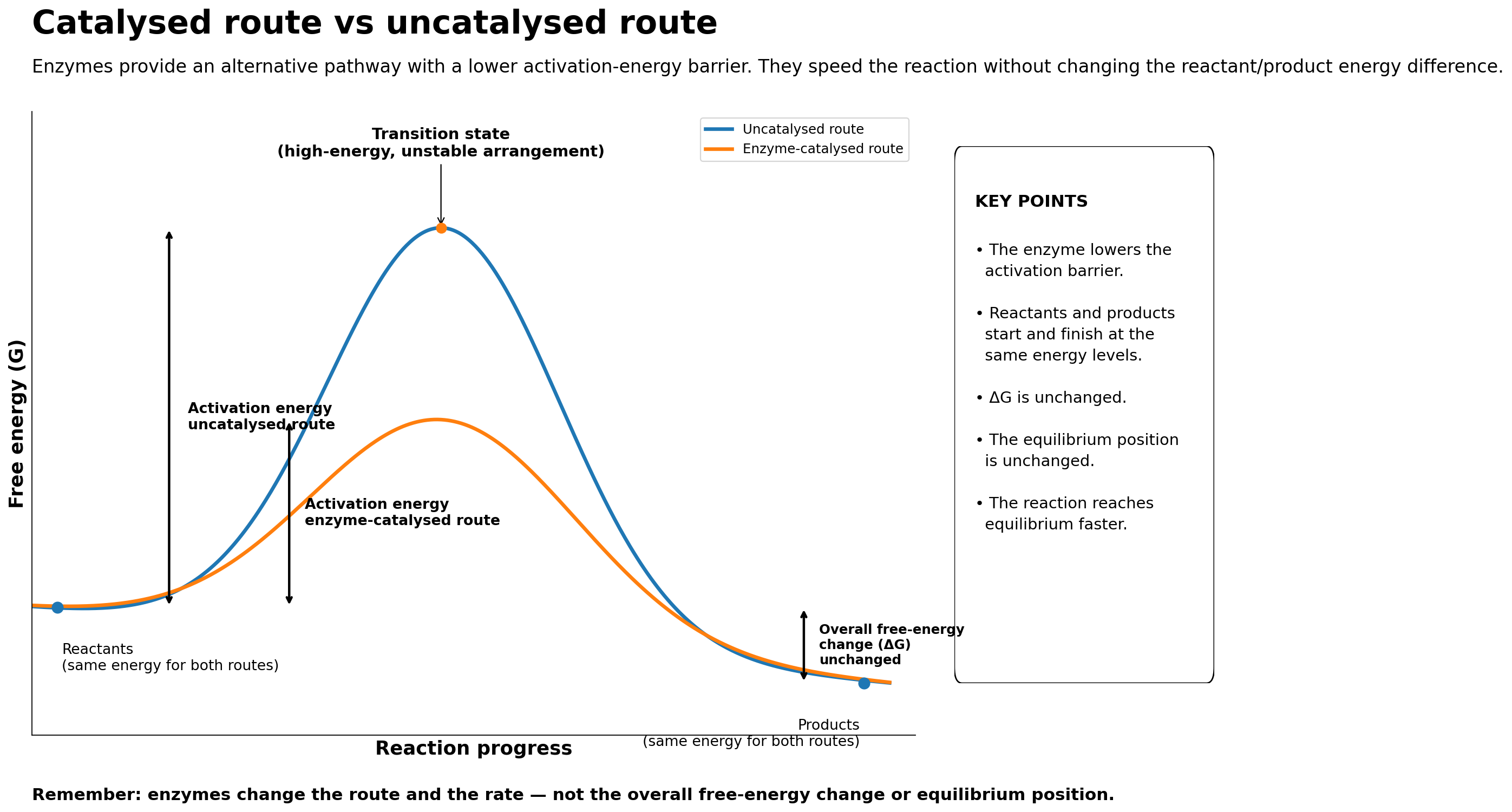
A reaction can be energetically possible and still happen far too slowly to support a cell. Reactant molecules must first pass through a high-energy, unstable arrangement before products can form. That temporary barrier is the key problem an enzyme solves.
“Possible” does not mean “fast”
Suppose a reaction would leave the products at a lower free-energy state than the reactants. That tells you the overall reaction can be favourable, but it does not tell you how quickly reactants can reach the products. Molecules usually need an initial input of energy to reach a highly unstable arrangement called the transition state.
The energy needed to reach that state is the activation energy. If the barrier is large, only a small fraction of molecular encounters have enough energy and suitable geometry to cross it at any moment. The reaction can therefore be very slow even though its products are energetically favourable.
An enzyme changes the route, not the start or finish
An enzyme provides an alternative reaction pathway with a lower activation-energy barrier. It does not change the free energy of the reactants or products, and it does not make an energetically unfavourable reaction become favourable simply by being present.
The same equilibrium position is therefore reached with or without the enzyme; the enzyme lets the system approach that equilibrium faster. It can accelerate both forward and reverse reactions because it lowers the kinetic barrier between the two states rather than “pushing” the reaction in one direction.
The enzyme is recycled after the reaction
During catalysis, an enzyme may bind a substrate, change shape and even form temporary chemical intermediates. But after product release the enzyme returns to a form that can catalyse another cycle. It is therefore a catalyst: it participates in the mechanism without being consumed overall.
The answer lies in the active site. Catalysis depends on bringing particular chemical groups together in a very specific three-dimensional environment.
Active sites & specificity
An enzyme does not act on a substrate simply because the two molecules collide. Productive binding requires the substrate to encounter a region whose shape, charge, polarity and chemical groups are compatible with it. That region is the active site.
The active site is a three-dimensional chemical environment
The active site is formed by amino-acid residues that may be far apart in the primary sequence but are brought together when the protein folds. Their side chains create a local pattern of charge, polarity, hydrophobicity and hydrogen-bond donors or acceptors.
A substrate can bind when its own chemical features make a favourable set of non-covalent interactions with that environment. Shape matters, but so does chemistry. Two molecules with a similar outline may bind very differently if one loses a charge or hydrogen-bonding group that the active site uses.
The substrate must be able to enter the binding region and place its reactive groups in useful positions.
Charged, polar and non-polar regions must make a sufficiently favourable pattern of interactions with the active site.
Induced fit is more useful than a rigid lock-and-key picture
Enzymes are flexible molecules. When a substrate begins to bind, interactions with the active site can favour a slightly different enzyme conformation. This induced fit can improve contact, position catalytic groups and help the substrate reach a reaction-ready arrangement.
The older “lock and key” analogy is useful only for the idea of selectivity. Taken literally, it makes the enzyme look rigid. A better picture is a complementary binding site whose shape and interactions can adjust during binding.
Specificity does not always mean one enzyme, one substrate
Some enzymes are extremely selective, while others can act on a family of related substrates. Specificity therefore means that the active site favours certain molecular features and reaction geometries over others — not that every enzyme recognises only one molecule in all circumstances.
A substrate must bind, but an enzyme is useful because it binds in a way that favours the reaction pathway and transition state. Very tight binding to the unchanged substrate alone would not automatically make catalysis effective.
Some enzymes need non-protein helpers
Not every catalytic task can be performed by amino-acid side chains alone. Some enzymes require cofactors. These may be inorganic ions such as metal ions, while organic cofactors are commonly called coenzymes. The important idea here is functional: the helper provides chemistry the protein itself may not provide efficiently.
Binding creates the right environment. The next step is to see how positioning, interactions and transition-state stabilisation turn that binding event into catalysis.
How enzymes lower the barrier
“Enzymes lower activation energy” is correct, but it becomes useful only when you can explain how an active site creates a lower-barrier route. Different enzymes use different mechanisms, but several recurring ideas make the logic understandable.
The transition state is the key target
During a reaction, old interactions are being weakened while new ones are beginning to form. The transition state is therefore unstable and high in energy. An enzyme can make this state easier to reach by creating interactions that are especially favourable for the reaction-ready arrangement.
This is often described as transition-state stabilisation. The enzyme does not simply “hold the substrate tightly”; it favours the molecular arrangement along the route to product.
Binding increases effective proximity and can hold the correct atoms facing one another, reducing the number of random, unproductive encounters needed before reaction can occur.
Local charges, proton donors or acceptors can stabilise developing charges and make bond rearrangements easier than they would be in the surrounding solution.
Binding can position or distort a substrate toward a geometry closer to the transition state, reducing the additional rearrangement needed to reach it.
Some enzymes form temporary catalytic intermediates before being regenerated. The intermediate is part of a different pathway with a lower overall activation barrier.
Why does the product leave?
The active site is organised to favour the catalytic pathway, but after the chemical transformation the product has a different arrangement of atoms and interactions. It may therefore fit the active site less favourably than the substrate or transition state and can dissociate, freeing the enzyme for another catalytic cycle.
An enzyme can change how fast equilibrium is reached. It cannot change the overall free-energy difference, create energy from nothing, or force a reaction to produce a different equilibrium mixture simply because catalysis is faster.
Catalysis happens at a finite number of active sites. That turns enzyme concentration and substrate concentration into measurable limits on reaction rate.
What determines reaction rate?
Enzyme activity is not a fixed number. The observed rate depends on how often enzyme and substrate form productive complexes and how many catalytic sites are available to work at the same time.
At low substrate concentration, more substrate usually increases rate
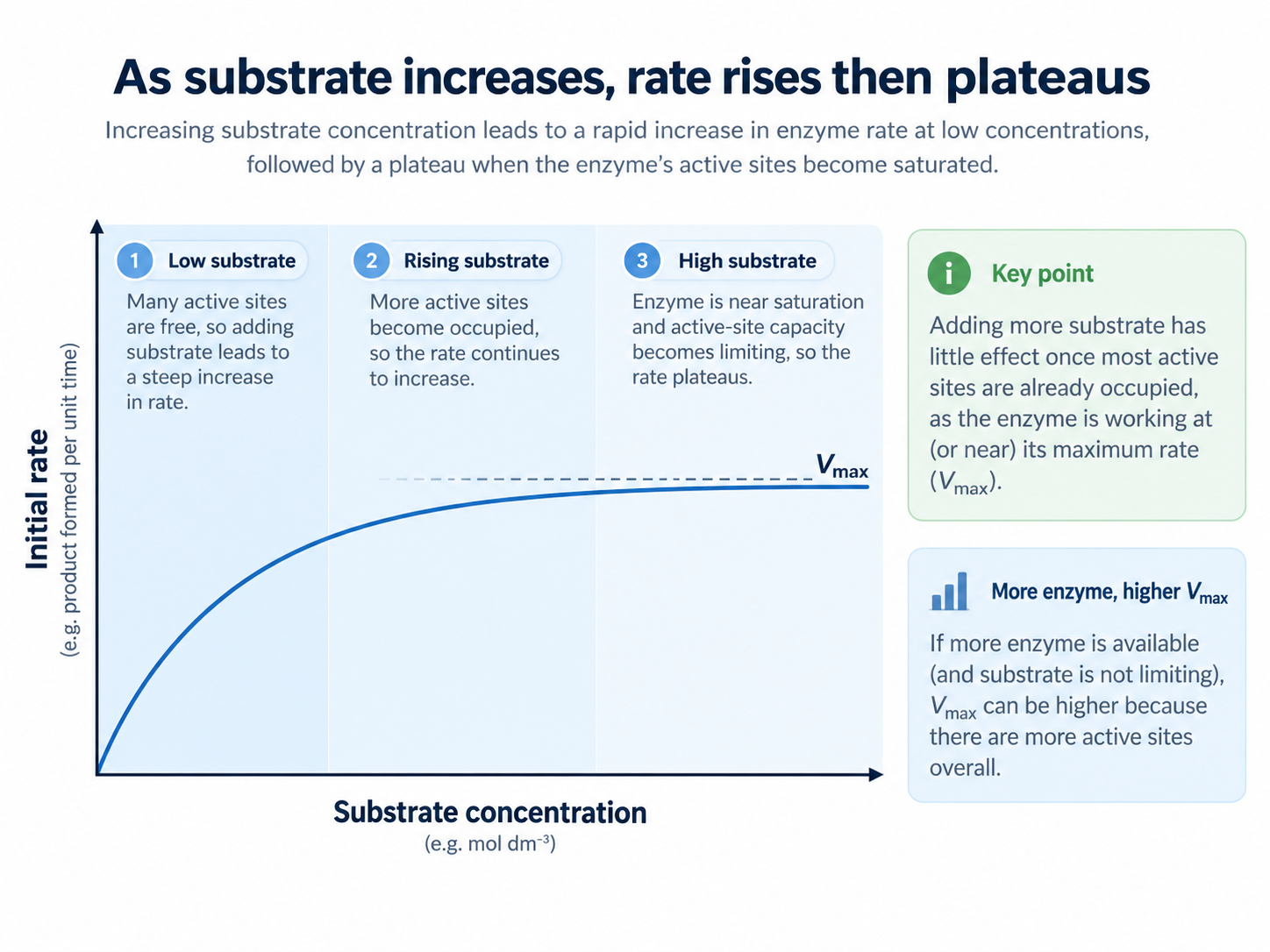
When substrate molecules are scarce, many enzyme active sites spend part of their time unoccupied. Increasing substrate concentration increases the frequency with which substrate reaches available active sites, so the reaction rate rises.
At high substrate concentration, the enzyme becomes saturated
Eventually, most active sites are occupied for much of the time. Adding more substrate cannot create more enzyme molecules or more active sites. The rate therefore approaches a plateau: the enzyme population is working close to its maximum capacity under those conditions.
More enzyme can raise the maximum rate — if substrate is available
Increasing enzyme concentration adds more active sites. If enough substrate is present, more enzyme-substrate complexes can form at the same time and the reaction can proceed faster. But if substrate is already scarce, simply adding enzyme may have little effect because many of the new active sites will remain empty.
Keep variables controlled when interpreting rate experiments
If an experiment changes substrate concentration, conclusions are meaningful only if important conditions such as enzyme amount, temperature and pH are kept comparable. Likewise, if enzyme concentration changes, there must be enough substrate to reveal the effect of the additional catalytic sites.
Concentrations control how often enzyme and substrate meet. Temperature and pH can go further by changing molecular motion, protonation and the structure of the catalytic site itself.
Temperature & pH
An enzyme works because a folded protein places specific chemical groups in precise positions. Anything that changes molecular motion, side-chain charge or protein structure can therefore change catalytic rate.
Temperature has two competing effects
As temperature rises from a low value, molecules generally move faster and productive enzyme-substrate encounters can become more frequent. Reaction rate therefore often rises at first.
But the enzyme is itself a structure stabilised largely by many non-covalent interactions. At sufficiently high temperature, those interactions can be disrupted enough for the protein to lose the active-site geometry required for catalysis. The activity then falls.
Greater molecular motion can increase the frequency of productive encounters and speed the reaction.
Loss of the folded arrangement can distort the active site and reduce catalytic activity.
Heat-induced denaturation mainly disrupts interactions that maintain higher-order protein structure. The primary sequence usually remains covalently linked; the enzyme loses function because its three-dimensional arrangement changes, not because every peptide bond is broken.
Low temperature usually slows rather than permanently destroys the enzyme
At low temperature, reduced molecular motion lowers the frequency of productive encounters. For many enzymes this effect is reversible: warming the system again can restore activity if the protein has not been damaged by some other process.
pH changes protonation — and active sites depend on charge
Lesson 01 showed that changing pH can shift the protonation state of carboxyl, amino and other ionisable groups. In an enzyme, those groups may be responsible for substrate binding, acid-base catalysis or interactions that stabilise the folded structure.
A pH change can therefore alter active-site charge even when the protein backbone remains intact. More extreme pH changes can disrupt enough interactions to alter the overall fold as well.
There is no universal “best pH” or “best temperature” for all enzymes
An optimum is a property of a particular enzyme under particular conditions. Different enzymes have evolved to work in different cellular and environmental contexts, so memorising one universal value such as pH 7 or 37 °C would be misleading.
A second molecule can interfere directly with binding or catalysis. The pattern of inhibition tells you where that interference is acting.
Enzyme inhibition
“An inhibitor lowers enzyme activity” is only the starting point. The useful question is where the inhibitor acts and whether extra substrate can overcome its effect. Different answers reveal different mechanisms.
Competitive inhibition interferes with access to the active site
A competitive inhibitor binds in a way that prevents substrate from occupying the active site at the same time. Substrate and inhibitor therefore compete for access to the enzyme.
Increasing substrate concentration raises the chance that substrate, rather than inhibitor, occupies an available active site. In the idealised competitive model, sufficiently high substrate concentration can therefore restore the same maximum rate reached without inhibitor, although more substrate is required to reach a given rate.
Pure non-competitive inhibition reduces catalytic capacity differently
In the textbook pure non-competitive model, the inhibitor binds at a different site and reduces catalytic activity without directly competing for the substrate-binding position. Substrate may still bind, but some enzyme molecules are no longer able to catalyse effectively.
Adding more substrate therefore cannot fully restore the lost catalytic capacity. The maximum rate is lower because the effective amount of functioning enzyme has been reduced.
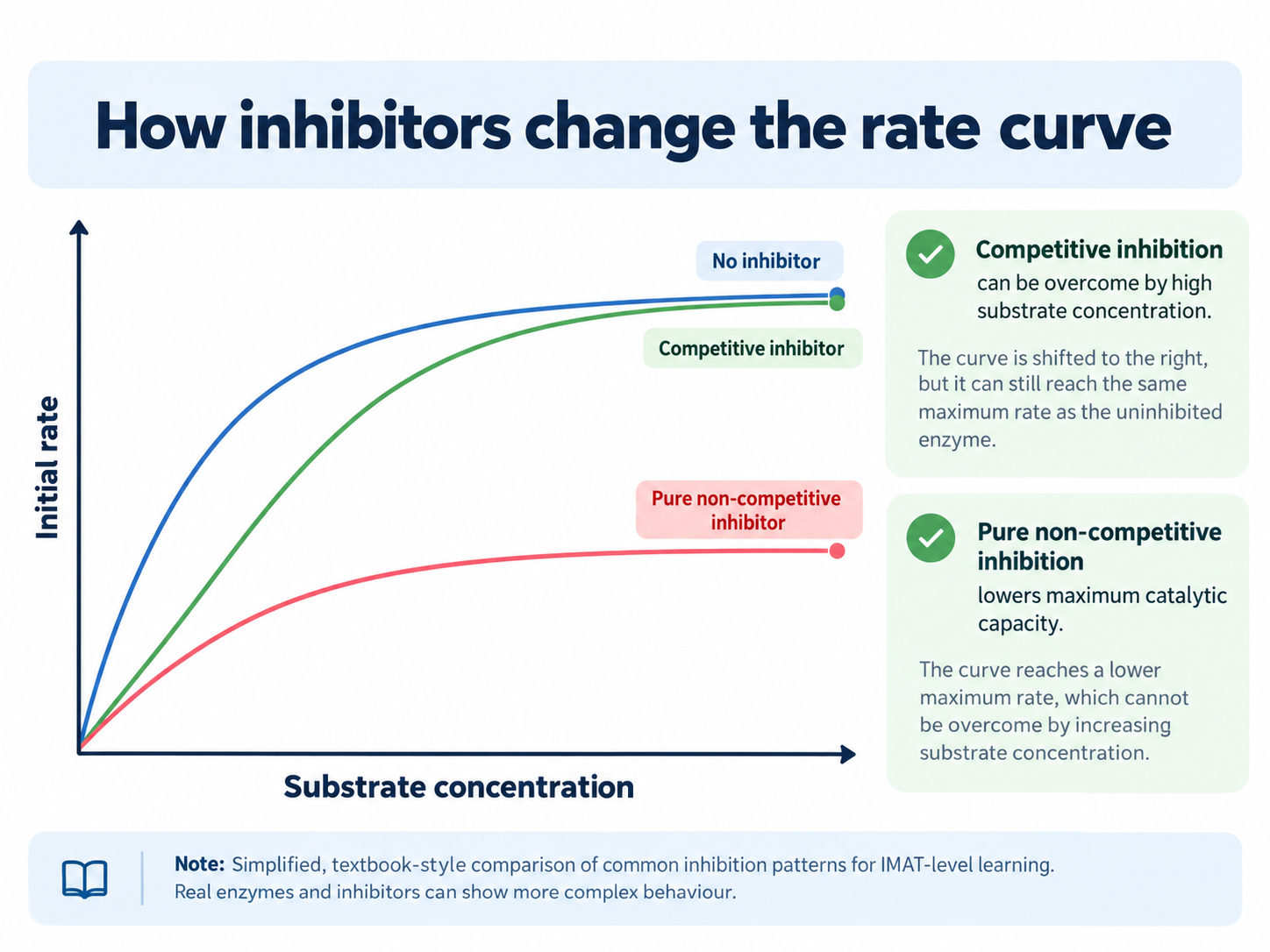
“Non-competitive” is often used loosely for any inhibitor that binds away from the active site. For this lesson, use the pure textbook comparison: competitive inhibition can be overcome by enough substrate, whereas pure non-competitive inhibition lowers maximum catalytic capacity. More complex mixed inhibition can be learned later if needed.
Allosteric regulation is broader than inhibition
A molecule binding away from the active site can stabilise a different enzyme conformation. That change may reduce activity, but allosteric regulation can also increase activity. “Allosteric” therefore describes regulation through a separate binding site, not automatically inhibition.
You now have the mechanisms. The final section turns them into a repeatable way to interpret rate curves, environmental changes and inhibitor experiments.
Read enzyme data & experiments
Enzyme questions often look like graph-recognition exercises, but the safest approach is to rebuild the graph from mechanism. Ask what variable changed, what molecular step that variable affects, and only then predict the rate.
Start with the variable that was changed
Substrate concentration, enzyme concentration, temperature, pH or inhibitor concentration?
Encounter frequency, active-site occupancy, protonation, protein structure or access to catalysis?
Available substrate, available active sites, correct active-site geometry or functioning enzyme molecules?
Rise, plateau, fall, shift relative to a control, or become less responsive to added substrate?
Translate common graph shapes back into mechanisms
Active sites move from frequently empty toward heavily occupied; enzyme capacity becomes limiting.
Molecular motion initially helps, but loss of active-site structure eventually dominates.
The enzyme depends on particular protonation states and structural interactions.
The pattern supports competition for enzyme access rather than a permanent loss of catalytic sites.
Do not confuse initial rate with final amount of product
A faster enzyme can produce more product in the same short time interval, but catalysis does not change the equilibrium position. If two otherwise identical systems are allowed to reach the same equilibrium, the enzyme changes how quickly they get there, not the equilibrium composition itself.
Use control comparisons before dramatic explanations
If a treatment lowers activity, do not immediately conclude that the enzyme has been destroyed. The active site may be reversibly occupied, a catalytic group may have changed protonation state, or substrate may simply be limiting. Choose the explanation that follows most directly from the variable changed and the pattern in the data.
At this stage, understand activation energy, active-site specificity, saturation, temperature and pH effects, and the qualitative patterns of competitive and non-competitive inhibition. Detailed Michaelis–Menten derivations and advanced enzyme kinetics are not required to understand the mechanisms developed here.